Saturday, May 10, 2014

Godzilla vs. The Sea Monster (1966)

It's not uncommon for a movie to have to compensate for an actor not being available for a movie planned specifically for them. Schedules, salary disagreements, and just plain lack of interest can all conspire to keep a planned project from coming together as intended, and sometimes a filmmaker can manage to pull it together with a different actor. But a case of the monster you wanted to use being unavailable? That's a bit more uncommon.

That's exactly what happened with Godzilla vs. The Sea Monster, though. In the mid-1960s, American producers Arthur Rankin and Jules Bass, whom I've previously discussed here, secured the rights to make a cartoon series about King Kong. As part of the deal, they had to produce a live-action feature film. Knowing this, they turned to Toho Studios for a collaboration--since Toho could easily produce a film that would cost less than the average American studio.

The first draft of Toho's King Kong film saw a group of teenagers in a sailboat finding themselves marooned on the island base of a terrorist organization, guarded by an enormous lobster. When the teens find King Kong sleeping in a cave, they wake him up to use as a defense against the terrorists and their pet crustacean.

However, Rankin & Bass weren't interested in this script. It was too different from their show for their tastes, so it was set aside and the next draft, which was more faithful to the show, would become King Kong Escapes. Toho obviously saw promise in the unused script, so with a quick bit of find and replace, King Kong was replaced with Godzilla.

And the rest is history.

Ryota (Toru Watanabe) lost his brother at sea several months ago. However, their mother visits a medium who insists that Yata (Toru Ibuki) is not in the land of the dead, so he must still be alive. Unfortunately for Ryota, the Japanese authorities don't really feel a medium's word is a good enough reason to expend resources searching the South Pacific for one guy. So when Ryota sees an ad for a dance contest where the prize is a sailboat, he rushes to get to it.

Unfortunately, it's an endurance contest that started 3 days ago. You can't very well join an endurance contest at the last minute. Ichino (Choutarou Tougin) and Nita (Hideo Sunazuka) have just washed out of the contest when they bump into Ryota. Apparently amused by the country boy's fascination with sailboats, the pair take him down to the docks to look at some.

They go aboard a fancy yacht, the Yahlen, only to find its apparent owner, Yoshimura (the imminent Akira Takarada), waiting for them with a rifle. Bizarrely, he agrees to let them stay the night as long as they're gone by morning. This proves a mistake, as Yoshimura, Nita, and Ichino wake up in the morning to discover that the Yahlen is already well out to sea, thanks to Ryota.

Oh, and Yoshimura's rifle is fake, he has a mysterious briefcase, he turns off a radio news broadcast right after it shifts from news of an American movie producer's stolen yacht to a report on a bank robber, and he makes skeleton keys for fun. But he's totally not a bank robber, you guys.

The Yahlen was fully stocked for an ocean crossing, so the four are doing just fine--until they run afoul of a storm. The storm quickly wrecks their helm and sets them adrift. However, that's a minor concern when an enormous lobster claw appears and obliterates their vessel. Luckily, they all wash up on the shore of a mysterious island alive. However, they quickly find the island isn't uninhabited. It's the base of a shady military organization, which they discover when a ship spraying yellow liquid arrives at the dock--and disgorges its cargo of captives from nearby Infant Island.

Three natives escape, one of them being gunned down in the process. The Guard Captain (Akihiko Hirata, wearing an eye-patch yet again) orders his men to cease pursuit when the two remaining fugitives make it to a canoe. The canoe doesn't get far before the giant lobster rises above the water, crushes the canoe, and them impales the two men on its claw to eat them like a kabob. In all the excitement, Dayo (Kumi Mizuno, long a fan favorite despite appearing in only two Godzilla movies prior to the Millennium series) escapes from the guards and runs into Yoshimura and the others. Unfortunately, the guards are in hot pursuit and now they know the castaways are here.

Luckily, the group is able to hide in a cave on a cliff. Dayo explains that the soldiers are the Red Bamboo, the giant lobster is Ebirah, and they are using the Infant Island natives as slave labor. Mothra is, oddly, napping throughout all this and ignoring the prayers of her people. So clearly the Red Bamboo are at least aware of the fate "Rolisica" suffered and did not lay a finger on the Shobijin (singing duo Pair Bambi, marking the first time the twin fairies are not played by Emi and Yumi Ito).

Ignoring the pain and suffering of her chosen people. Typical God behavior, really.

Dayo also reveals that Yata is alive and well on Infant Island. Yoshimura decides that the group should sneak into the Red Bamboo base to find out what they're up against. Ryota and Dayo are up for it, but Nita and Ichino would rather stay in the cave--until Nita happens to notice that the cave is not as empty as they thought.

Fighting space hydras really takes it out of ya.
Not eager to hang around a sleeping Godzilla, the whole crew attempts to infiltrate the Red Bamboo base. They manage to steal some smoke bombs and Dayo grabs a coil of copper wire to use as a necklace, but after discovering the base is a heavy water factory--to make nuclear bombs--the Guard Captain finds them. In their escape attempt, Ryota gets tangled in a weather balloon and floats away and Nita is captured. Nita quickly discovers the natives are being forced to crush yellow berries into juice--apparently these berries have a repellent effect on Ebirah, which allows the Red Bamboo ships to come and go unharmed. Nita proves smarter than he looks and suggests that they whip up a batch of the repellent using only the leaves so that it will be useless against Ebirah the next time a Red Bamboo ship tries to leave.

With the Red Bamboo combing the island for the castaways, Ichino comes up with an idea so crazy it just might work: use lightning to wake up Godzilla.

Ryota, meanwhile, lands on Infant Island and is reunited with Yata. Somehow, despite having been on the island long enough to know Dayo, Yata has not heard of the Red Bamboo. He can't bear to think of people suffering, so he and Ryota load up a canoe with barrels of yellow juice and head back to what the Shobijin term "Devil's Island." Unfortunately, a storm whips up and washes away their barrels--so they have no defense when Ebirah appears.

Luckily, the plan to wake up Godzilla worked beautifully. Godzilla bursts out of the cliffside and challenges Ebirah. The two bat rocks back and forth, until one rock goes astray and smashes a guard tower--alerting the Red Bamboo of Godzilla's presence. Ebirah proves oddly resistant to Godzilla's radioactive breath, but after a scuffle underwater the lobster retreats.

Ryota and Yata reunite with the group, but their attempt to sneak into the Red Bamboo base just results in them being pursued again. Dayo gets separated from the group and winds up at Godzilla's feet. Oddly, Godzilla seems a bit interested in Dayo--but then, she is played by Kumi Mizuno. When Godzilla begins to take a nap, the others move in to rescue her...

...only for a giant condor to appear out of nowhere and attack Godzilla. I imagine in the original script this played like a recreation of the King Kong vs. Pteranodon fight from the original King Kong. In the final film, though, the condor annoys Godzilla for a bit until it discovers the true price of taking on something that spits radioactive fire when you're covered in feathers.


Godzilla attempts to go back to sleep, only for a squadron of Red Bamboo fighter planes to appear. Godzilla's destruction of the plains is, delightfully, set to surf guitar music. The plane attack serves only to annoy Godzilla into destroying the Red Bamboo base, which allows Yoshimura and Yata to free the captives--but they're too late to stop a Red Bamboo scientist from triggering a self-destruct device that will obliterate the whole island in two hours. And when Godzilla crushes the building, the falling debris makes the shut-off switch impossible to reach.

Now all the heroes can do is hope that Mothra will finally wake her damn ass up and come rescue them before the whole island is vaporized.


As a kid, this was unquestionably my favorite Godzilla film. This was partly because it was among the ones I had the most access to because a neighbor recorded it off the Disney Channel for me. I once drove a babysitter to madness because of how often I wanted to watch it. Even now, though, it delights me to no end.

That the film was meant for King Kong is painfully obvious, of course. Godzilla had, after all, just spent two movies fighting King Ghidorah--one of his most powerful foes. A giant lobster with zero offensive weapons is a step down in every conceivable sense. What's more, most of the fight scenes require Godzilla--an amphibious creature--to behave as if he is out of his element in the water.

Ebirah dragging its opponent back down to the ocean floor after he attempted to get a breath is a suspenseful moment--if the opponent is a giant gorilla. We've seen Godzilla taking naps under the ocean repeatedly. It's no skin off his nose to be unable to reach the surface. For that matter, I'm not certain that Godzilla would even have been harmed by the island exploding if he didn't leave in time, unlike Kong who would definitely have been killed.

Plus, there's the whole "beauty and the beast" moment. Again, it's Kumi Mizuno we're talking about here and it is played down a lot more than it would be with Kong, but it's still odd that Godzilla would have any interest in a tiny human woman at all.

"Society and all its Maser cannons can never stop our love!"
So, yeah, Godzilla's opponent is less than impressive and the film is set on a tropical island, which cuts down on the city destruction significantly. This seems to be the major beef that many older Godzilla fans have with the movie. This movie is also a far cry from the dark and starkly terrifying 1954 film, so I'm sure the newer fans who seem to think that Godzilla should only ever be serious and a grim nuclear allegory would hate this film with every fiber of their being.

Nuts to that, on both counts. This movie, to me, exemplifies one of the aspects of Godzilla that is oddly forgotten in most discussions--the character's versatility. Yes, in the long run there's only so much you can expect out of a 150-foot radioactive dinosaur, but he can be anything from the dark avatar of nuclear weapons to valiant protector of the Earth. Godzilla is a character, not just a metaphor. And Godzilla is one of the few fictional characters to go from villain to hero and back again--and have it make sense every time.

This film is not meant as a metaphor. It has no message. It is meant to entertain only. So does it succeed at that goal? And how!

This film was the first time that Jun Fukuda would sit in the director's chair, making it only the second Godzilla movie not to be directed by Ishiro Honda. It's also the second film in the series to feature Masaru Sato as composer, but thankfully in this film Sato is allowed to use his own style--as opposed to Godzilla Raids Again, which saw him shamelessly ripping off Max Steiner's King Kong score.

Jun Fukuda was a very workman-like director. Unlike Honda, he didn't really have a knack for disctinctive framing choices and leitmotifs. However, that didn't stop this film from having a lush, candy-colored palette--it looks amazing on Blu-ray, where its technicolor glory truly pops.

If you ask me to chose Akira Ifukube or Masaru Sato as my favorite Godzilla composer, I'd have to honestly think hard on it before choosing. While this film is not Sato's finest work on the series--that honor goes most definitely to Godzilla vs. Mechagodzilla--his score here is delightful. It takes manny of its cues from surf rock, as befits a film set on a tropical island. And while Sato's version of the Mothra song is hardly equal to the traditional theme, originally composed by Yuji Koseki, it's a nice spin on it that manages to be its own thing.

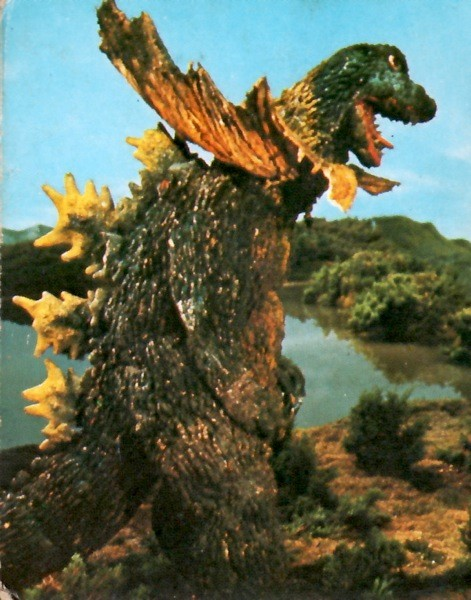
The effects for the film are largely great--provided you're not so lacking in imagination as to automatically label anything involving men in suits and miniature buildings as "bad effects" without any appreciation of the effort involved--though the monsters are a bit of a mixed bag. The Godzilla suit--originally used in Invasion of Astro-Monster--is actually one of my favorites, despite its resemblance to Cookie Monster, but it does look a bit haggard. It's possible that this was filmed after the suit was used as Jirass on an episode of Ultraman, so having to repaint it and cover up the spot where the frill was attached would account for some that. Mothra, on the other hand, looks godawful. The puppet looks, fittingly, moth-eaten and dirty; as though it was taken out of storage minutes before filming. Cripes, it even has a cigarette butt on the side of its head in one shot.

Maybe Mothra was like Steve McQueen in The Blob and she just refused to stop smoking during filming?
Ebirah, on the other hand, looks amazing. The creature is constantly in motion: its eye stalks wiggle, its feelers wave, and its mandibles are continually working. Add to that the fact that the creature was largely a man in a suit, yet the actor's legs--which would jut out at the totally wrong angle to be convincing as a crustacean--are never visible, and you have a fantastically realized monster.


Oh, yeah, and the giant condor looks okay, I guess.

The human story is ultimately where any monster movie fails, though. Sure, we come to see the monsters, but a movie that is 90 solid minutes of monster action is simply not feasible so the non-monster sections need to be compelling or it will be an exercise in boredom or frustration.

Luckily, this film's human story is great. The teenagers and the Red Bamboo don't really make much of an impression outside of the always reliable Akihiko Hirata charmingly evil Guard Captain, sure, but Kumi Mizuno is always welcome--and not just as a pretty face. The real standout is Akira Takarada as Yoshimura, though. This was Takarada's fourth and final Godzilla film until he returned to the series briefly in 1992's Godziilla and Mothra: Battle For The Earth and in 2004's Godzilla: Final Wars, and it is easily my favorite character of his. Yoshimura is a charming rogue with a hidden moral compass that actually points due North, similar to what made Han Solo so popular. The film would definitely not be as enjoyable without him.

In the long run, if you're expecting a serious Godzilla film with a strong central message, you need to look elsewhere. If you want a film that's entertaining, light-hearted, and fun? This will fit the bill perfectly.

Sunday, May 4, 2014

Gorgo (1961)


Typecasting can be a pain in the ass. As an actor, you may want to play Othello but you end up stuck as the guy who plays a cross-dressing Mammy stereotype. As a director, you may want to do an inspirational film but you're just seen as a horror film director.

And then you have the weirdly specific typecasting. Eugene Lourie, a Ukraine-born French director is known specifically for three films that are so alike in subject matter that you could easily call them a trilogy--The Beast From 20,000 Fathoms; The Giant Behemoth; and today's film, Gorgo. You may have picked up that Gorgo is not a biopic about the queen of Sparta and that all three of these films are about giant monsters. Giant amphibious dinosaurs, to be specific.

Lourie was so frustrated at having been shoehorned into these films that after directed Gorgo he quit directing so he wouldn't be stuck making "the same comic-book monsters." Somewhere, with fourteen kaiju movies under his belt, Ishiro Honda calmly drags on a cigarette and chuckles.

The amusing thing about Lourie's trilogy of sea monsters is that the latter two films feel weirdly like response pieces. The Beast From 20,000 Fathoms was, in essence, a game changer. In 1953 it set the stage for the majority of giant monster films to follow--beginning, as it does, with a nuclear blast releasing a giant dinosaur from the arctic ice and setting it loose to destroy a major city.

The original Godzilla drew inspiration from this, but whereas the nuclear explosion in The Beast From 20,000 Fathoms is only a MacGuffin to set the plot in motion, Godzilla is all about the dangers of nukes. Even in the cut-up and re-edited Godzilla, King of the Monsters! that the film was released as for American audiences, Godzilla is still a walking avatar of nuclear weapons. He is indestructible, radioactive, and beyond human control.

Lourie seemed to have a bizarre need to one-up the creature that had arisen as a result of his own creation. The Giant Behemoth is, like Godzilla, a giant amphibious dinosaur that was minding its own business at the bottom of the sea until nuclear contamination drove it out, and like Godzilla it can discharge its own radiation as a weapon. Unlike Godzilla, the Behemoth is slowly dying of its radiation and is therefore a mortal creature to begin with.

But Gorgo is the most blatant attempt by Lourie to one-up his apparent saurian nemesis. You see, both The Beast From 20,000 Fathoms and The Giant Behemoth used stop-motion effects for their monsters. (And a truly unfortunate prop head in The Giant Behemoth, which we will get to eventually) Gorgo, on the other hand, takes a page from Toho studios and renders its monsters with a man in a suit destroying miniature sets. Lourie apparently wanted to beat Toho at their own game by doing it better.

How did he do in his attempt? Well...

We open off the coast of Ireland, as Americans Captain Joe Ryan (Bill Travers, who looks rather like Dominic West to give any fans of The Wire material for riffing) and his first mate Sam Slade (William Sylvester, better known for 2001: A Space Odysssey) are anchored in order to exploit the riches of a sunken ship. Suddenly, a volcano rises up out of the ocean and erupts--the resulting rough seas nearly capsizing their vessel. With the rudder damaged, they're forced to go ashore to get supplies on nearby Nara Island until they can repair it.

On the way in they encounter several (patently rubber) dead fish that look like nothing either of them has ever seen. Clearly the volcano displaced everything from even the deepest part of the ocean. Ashore the men find themselves not exactly welcomed by the inhabitants, who refuse to even speak anything but Gaelic at them. The most welcoming native is Sean (Vincent Winter), an orphaned young lad who either lives with the harbormaster or just hangs around to let strangers inside to show them the Viking artifacts the self-styled archaeologist has found and tell them about Ogra, the legendary sea serpent. McCartin (Christopher Rhodes), the harbormaster, is less than thrilled to have two salvage men around all his stuff when he comes home and tells them they can't stay in his harbor more than 24 hours.

However, something is about to force McCartin to deal with the sea raiders a bit longer. Two divers have gone missing and when one is found, he promptly dies--seemingly of fright. (As opposed to the bends, caused by coming up too fast due to fright, which seems more likely) The dead man had gold doubloons with him, so Joe and Sam figure McCartin was trying to keep them out of his treasure stash and decide to dive down to find the source. Instead, they glimpse what caused the diver to die of fright--a huge reptilian creature, and they decide that the gold is not worth the risk.

As Joe and Sam are loading up in order to leave Nara, they summoned by Sean to meet with McCartin. They observe a group of boats searching for the shark they think got the missing diver--but naturally they find what really did it when one of them throws a harpoon at a disturbance in the water and promptly a 65-foot dinosaur bursts from the water and smashes the boats. Sean, watching the creature from the shore, identifies it as Ogra. Unfortunately for Nara, Ogra is amphibious and charges ashore--harpoons and bullets only angering it further. Fortunately, Joe and Sam discover that the beast is terrified of fire and drive it back into the sea by flinging torches at it.

Joe and Sam, our heroes, see that the islanders are terrified and furious--so they blackmail McCartin  into opening his safe and giving them all his gold coins and treasures in exchange for them capturing Ogra. Sean warns them that what they're doing is a terrible bad thing, but being adults in a kaiju movie they ignore the child who intrinsically knows everything about the monsters. Maybe if he was wearing tiny shorts they'd listen.

Having apparently never seen The Beast From 20,000 Fathoms, Joe volunteers to go down in a diving bell as a lure for the monster. It works.

"Gah! This was a bad plan and I should feel bad!"
Luckily for Joe, his boat crew are more on the ball than the last time someone tried to observe a Lourie monster in a diving bell and he escapes with nothing worse than a sea water shower, Ogra is netted and hoisted aboard somehow. Joe and Sam immediately notify the media and offer the beast to the highest bidder. They at least let two paleontologists from Dublin--Professor Hendricks (Joseph O'Conor) and Professor Flaherty (Bruce Seton)--examine the captive Ogra and imply that they'll take it to the University of Dublin, and even take the advice of the scientists that a steady stream of water should be run over the creature so its skin does not dry out. However, they just received a wire from Dorkin's Circus in London that's a much, much better offer. So for London they set sail.

Unbeknownst to them, Sean has stowed away on board. Joe catches him in the process of trying to free Ogra. Somehow this is what prompts Joe and Sam to post a guard on the animal with a rifle. After stowing Sean in a bunk, they observe that the water off of Ogra is leaving a phosphorus trail--right before they hear the guard scream. The guy was on guard duty for about five minutes and somehow got himself killed by Ogra, but damned if I know how given the creature is so tied down it can't move its front paws more than two feet. He won't be the last person to die.

Mr. Dorkin (Marin Benson) re-christens the creature "Gorgo", apparently after the Gorgons of Greek Mythology, and has it paraded through London on its way to Battersea Park. During the attempt to load Gorgo into its enclosure, a typically reckless newspaper photographer runs up takes a flash photo of the beast and wakes it from its tranquilizer-induced stupor. After a brief rampage that kills no one, the beast is driven back into its enclosure by flamethrowers--only for its tail to casually swipe some idiot who chose to stand too close as the creature makes its way into the enclosure. So really Gorgo is only a threat to to the suicidally stupid.

Naturally, while the University of Dublin is trying to sue to get Gorgo back, the exhibition of the beast--in his pitifully small enclosure with a token attempt at giving the beast some water to wet its feet--is a huge success. Joe is delighted by the success, Sam sits in his trailer and drinks. He can't shake the feeling that something is going to go wrong, and the riled up behavior of the other circus animals just convinces him all the more. So when Professors Flaherty and Hendricks summon them in the middle of the night, their news is all Sam needs to hear.

You see, Gorgo is only a baby. And if Gorgo is a baby, he must have a mama. And if Gorgo is a baby at 65 feet, well, its mother would be 250 feet tall.

"We're boned."
The professors advise that they will be notifying the authorities, over Joe's strong objections. And right on cue, the true Ogra rises from the sea and smashes her way across Nara Island as she follows the trail her child left, killing McCartin in the process.

When the military stock footage--er, I mean fleet goes to investigate they find Nara Island destroyed and fire upon Ogra when she shows her head above water. They assume she is dead--until she resurfaces and sinks a Destroyer.

Sam wants to let Gorgo loose, but Joe refuses and the British military sees no reason that Dorkin can't be allowed to hold onto the creature. Surely they'll kill its mother soon enough. Sam attempts to free Gorgo on his own but Sean (oddly enough) stops him with Joe's help.

However, the full might of the British Navy is for naught. Ogra tears through the anti-submarine nets and makes her way into the Thames. An attempt to flood the Thames with petrol and set it alight succeeds only in killing some careless onlookers. Tanks are sent to bombard the beast at tower bridge, but she simply smashes her way through.


Now she makes her way through London, smashing buildings in her path and crushing hundreds of civilians with rubble. She smashes Big Ben--though with the military's help since they shoot right through it to get at her--and continues with frightening determination towards Battersea Park. But of course, at no point does anyone suggest that maybe, just maybe they ought to give back her offspring before the entirety of London is left in ruin.


Gorgo is hardly the best of Eugene Lourie's sea monster trilogy. That honor goes, without question, to The Beast From 20,000 Fathoms. I would say, however, that this film runs a close second.

For one thing, there were few giant monster movies outside of the original Godzilla to truly consider the scope of an enormous creature rampaging loose in a major city. The onscreen death toll of this film is impossible to count--people trampled by crowds, set afire, electrocuted, drowned, and crushed under tons of rubble. The shots of Ogra in front of a night sky turned red with the flames she has created are downright nightmarish, as are the endless shots of frightened civilians crushed under falling bricks.

And it's hard not to appreciate a movie that ends with the stupid humans who kept trying to kill Ogra rather than give back her child watching helplessly as she finally rescues her child and they turn from the ruined city to return to the sea. Apparently, this was done because Lourie's daughter was saddened by the endings of his prior two films where the monsters had to be killed for the good of mankind. Either way, Gorgo and Mothra both hail from 1961 and remain rare examples where the monsters are rampaging because they are trying to get back something precious to them--and are allowed to leave, victorious, at the end.

As for the monsters, going back to my earlier point--Lourie had expressed a desire to have his monsters be more believable than Godzilla and with more personality. Quite simply put, he failed. Don't get me wrong, I love the creature designs for Gorgo and his mother. They're incredibly memorable creatures with crocodilian hides and wiggling fin ears. Clearly even Toho liked them, given they must have been an influence on the design for Titanosaurus.

Little flappy fin ears are all the rage!
However, Lourie apparently insisted on lots of internal machinery that would move the creature's tails and give them more of realistic presence. The end result is...they don't look any different than Toho's creations that used wires to manipulate that tails. In fact, the suits are far more stiff and inexpressive than Godzilla--though that is due largely due to the fact that Mick Dillon, the man in the suit, does not have the same sense of character that Haruo Nakajima did. Gorgo and Ogra flap their jaws entirely at random and swing their huge front paws around willy-nilly. That the suit has red, light-up eyes and absolutely zero details inside the mouth doesn't help--the suit makers did a marvelous job detailing the suit's skin and then just gave up, from all I can tell. Which is a shame, since the eyes are one of the most important parts of a monster.

And I said "suit" rather than "suits" since I honestly believe they only made one. There's no effort made to make Gorgo look different from its mama, to the point that some shots of the two creatures were clearly mixed up in editing.

The rest of the film's effects just make you appreciate Toho's all the more. Apparently this film cost millions to make, and I'd wager the majority of that money went into optical composite and rear projection in sequences that absolutely do not require it. For instance, a ghostly reporter (Maurice Kaufmann) who impossibly shows up at every part of Ogra's rampage, awkwardly composited into the shot.

Of course, given that all the optical effects are Godawful and the film would be a good ten minutes shorter without the military stock footage, it's entirely likely that the majority of the film's budget went into the pockets of its producers, the King Brothers, as they were known crooks.

As far as the human story, well, it falls pretty flat. Joe and Sam, our supposed heroes, are opportunistic cretins not afraid to blackmail at the drop of hat--and willing to let all of London be turned into a parking lot rather than give up their cash cow. That neither of them--not even Joe, arguably the more mercenary of the two--get any comeuppance is rather ridiculous. Though, I'm sure that like the opening of Son of Kong, the entirety of London's survivors sued them for every penny they ever grabbed as soon as the closing credits finished rolling.

All things being equal, I am still very fond of this film. As a giant monster film, it definitely delivers on the destruction and its monsters--for all their faults--are incredibly memorable. If you love giant monster films and haven't seen this, I definitely recommend you rectify that at once. If you don't love giant monster movies, then you're already beyond help.

Monday, April 14, 2014

Cloverfield (2008)


Unbelievable as it may seem now, there was a brief period of time where hearing that J.J. Abrams was attached to a project was something that elicited excitement instead pained groans. Before Lost ultimately whimpered to a close and before he cast the whitest of white guys as Khan Noonien Singh, Abrams was attached to a great deal of loved properties.

So when an unnamed teaser for what was unquestionably a found footage giant monster movie made its debut before Michael Bay’s first Transformers with Abrams’ name attached as a producer, there was an understandable amount of excited buzz instead of trepidation. As the months ticked on to the film’s release, though, a lot of the hallmarks of everything wrong with Abrams began to come forward.

The first was not really Abrams’ fault: the movie had no title. They had cut a teaser before they even fully had an idea of what they were teasing us with. The title “Cloverfield” was actually some kind of placeholder name or shooting title that the internet inevitably got ahold of. So despite attempts to rebrand the film (the only one I recall being the generic “Monstrous”), the filmmakers eventually succumbed to the inevitability of Cloverfield. The rest, however, was completely Abrams: the endless mysteries and viral marketing.

Viral marketing I have no issue with, but the mysteries served no purpose—as they almost never do with Abrams. The final film is a found footage film following a group of “regular” schmucks as they try to make their way through New York City as a giant monster lays waste to it. Obviously, this group is going to have no clue what the monster is or why it’s attacking the city. Therefore, littering hints about the monster’s origin is pointless. It literally has nothing to do with the movie itself.

However, there was one mystery worth obsessing over: what the Hell does this monster look like? The film followed the same marketing strategy as the 1998 Godzilla film and attempted to keep the monster’s design under wraps until its premiere. Unlike that film, they were actually successful. It was not until the film premiered that some fan sketches began to leak out. After seeing this one…


…it was impossible to not be excited for this wonderfully bizarre creature. It’s a shame, then, that the artist had given us a better monster than we get in the film itself.

The film opens with a Department of Defense title card indicating the following footage is codenamed “Cloverfield” and recovered from the area formerly known as Central Park. We are then introduced to Rob Hawkins (Michael Stahl-David) and Beth MacIntyre (Odette Yustman), as they revel in the afterglow—which Rob is taping for some reason. Beth admits she has never gone to Coney Island in her life, and Rob decides that they must go—

—and we cut to Rob’s brother, Jason (Mike Vogel), fumbling with the camera. Jason and his girlfriend, Lily Ford (Jessica Lucas!), are trying to get everything together for a going away party for Rob. Thanks to the date stamp on the video, we can tell this is months later than the footage of Rob and Beth. As they get things together for the party, Jason pawns the camera guy responsibility off onto Hudson “Hud” Platt (T.J. Miller), advising that Hud is to get statements from people wishing Rob well on his new job in Japan. Hud will be the audience’s eyes from here on.

Yes, the guy filming the events of the movie is named “HUD”. I bet the screenwriter strained himself patting himself on the back for that.

Hud quickly turns out to be the wrong guy to give the camera to. He lingers on women’s chests and people passed out on couches, barely films the well wishes that are his only reason for having the camera, and ultimately uses the camera as an excuse to harass poor Marlena Diamond (Lizzy Kaplan!). Marlena is clearly not interested in him and is only there because Lily invited her, but Hud is incapable of taking a damn hint.

Rob arrives to the party solo, and when Beth arrives she has some other guy with her. There is clearly some animosity between Rob and Beth, and Hud decides that is it important to find out why. To shut him up, Lily mistakenly spills the fact that Rob and Beth slept together. Hud then goes around telling everyone at the party what he just found out.

While Hud is certainly a dick, Rob isn’t much better. His poor attitude causes Beth and her date to leave early. So Beth isn’t there when a powerful tremor and an unnatural bellow shake the building. Turning on the news, the partygoers see that a tanker near Ellis Island just sank under mysterious circumstances. Since the tanker was nearby, they go to the roof to see if they can see what’s going on. They get their wish—a massive explosion in another location several blocks away rains fiery debris onto the roof.

Fleeing into the street, the partygoers barely avoid the severed head of the Statue of Liberty as something launches it at them. Whatever threw it is clearly large and alive, but Hud is unable to get a clear look at it. However, when Hud, Rob, Jason, and Lily find a dazed Marlena wandering around after the creature passes, she sickly tells them that she saw the thing eating people.

The group attempts to cross the Brooklyn Bridge, with Hud filming everything because he believes it is necessary to document this experience, but Rob gets a call from Beth just as they get onto the bridge. All she can say on the call before they are cut off by Rob’s battery dying is that she is hurt and trapped in her building. Rob is so eager to go save his one-time paramour that he doesn’t even notice that Jason has gotten separated from the group. As Lily and Hud call to Jason, the creature makes another appearance by smashing the bridge with its tail—killing Jason and collapsing the crowded bridge.

Having lost his brother, Rob is even more determined to save Beth, even after a quick stop to get a phone battery from an electronics store that’s being looted allows Hud to see via the televisions that the monster is only a few blocks away using a building to dislodge small objects from its back. Said objects turn out to be some kind of parasites: fanged crustaceans the size of a German shepherd, who are perfectly content to attack humans once dislodged from their host.

Rob is determined to go to Beth regardless of the various exciting forms of death waiting around every corner of the city now, but tells the others they can go to safety if they want. Lily, having also lost Jason, wants to make sure they don’t lose anyone else. Marlena oddly decides she will tag along, so Hud tags along to stay with Marlena.

Their journey gets off to an immediately rocky start. They find themselves caught in the middle of a firefight that a battalion of infantry and tanks gets into with the monster and are forced to take refuge in the subway. Once in the subway, Rob gets a call from his mom and is forced to A) lie to her that they are currently on their way out of the city and B) tell her that Jason is dead. Since the streets are currently a war zone, the group decides to brave the subway tunnels with only the light on the camera as a guide.

This quickly turns out to be a bad idea. Marlena notices that there is a flood of rats fleeing in the same direction the group is headed. Worse, something is clearly in the tunnels behind them. Hud decides to switch on the camera’s infrared to see what it is—and immediately regrets it as he gets a good look at the approaching pack of the parasite creatures right before they charge out of the darkness. Lily is the first attacked, but in the attempt to save her, Hud is dragged off into the darkness by one of the parasites. Marlena rescues him but takes a nasty bite to the shoulder for her troubles.

The group barely manages to find a maintenance door, duck inside, and close it behind to keep the little bite-happy bastards at bay. Since the tunnels are obviously no longer an option, the group heads up and finds themselves inside a department store that has become a makeshift army HQ. Men in hazmat sits trundle past with a dead parasite and—forebodingly—a dead soldier who appears to have been torn open from the inside by some kind of explosion, as Rob pesters the men in charge for some assistance in getting to Beth’s apartment. Despite the fact that Marlena was bitten by a parasite and was just complaining about feeling sick and dizzy right before the group stumbled on the army, nobody bothers to mention this to any of the medics…

…until Hud notices that Marlena is bleeding profusely from the eyes and nose. A frantic medic screams, “We’ve got a bite!” And before any of the group can even process what’s happening, a group of men in hazmat suits drag Marlena into a quarantine tent and Hud records the silhouette through the tent wall as Marlena expands like a ripe tick and explodes messily.

The film’s most likeable character having been killed off, Staff Sergeant Pryce (Billy Brown) takes the others aside and advises that, against his better judgment, he is going to let them go to try and rescue Beth. There is a chopper waiting in another part of the city but if they don’t make that chopper, then they’ll be caught in “Operation Hammer Down”: a last-ditch effort to kill the apparently indestructible monster by bombing Manhattan into oblivion. So now Rob, Lily, and Hud not only have to dodge the giant monster, its parasites, and the military to get to Beth’s apartment—if they don’t save her by 0600 hours, it will all be a moot point.

Cloverfield is a rather divisive film, with good reason. As a giant monster film, it takes on the very under-utilized aspect of even the best giant monster films—the street level view of the monster rampage—and makes that its entire focus. Some would argue this is a bad idea because we came to a giant monster movie to see giant monsters, but most of us are smart enough to realize that the human story is what keeps the film going. No, the bad idea is the group of people they chose to follow.

A monster film where the protagonists are ordinary people and not military or government scientists is hardly a bad thing--especially because then they know as much about the monster as the audience, or perhaps even less--but the group this film chooses is a bunch of yuppie douchebags. I hesitate to call them hipsters, but they're on the cusp. When I originally saw the movie I actually rather liked them--but subsequent viewings have driven home just how obnoxious most of them are. Marlena is actually a great character--at least 90% thanks to Lizzy Kaplan's performance--and I do like Lily, but that may have more to do with my attraction to Jessica Lucas than anything as Lily is rather a non-entity as characters go.

Hud, Jason, and Beth are the characters we most need to like, though, since we spend the most time with them. Whenever the camera is stopped or jostled we get little flashbacks of their happy day together at Coney Island, and they seem likable enough there. However, Rob is a selfish prick in the main film and Beth is given little to do but call him on it (yay) and whine and whimper (not yay). To be fair, I'd be whimpering too if I'd taken a chunk of rebar to the shoulder, but it doesn't make for a terribly engaging character and ultimately she's more of a MacGuffin to keep the characters in the city while a monster tears it apart.

Hud, however, is the audience surrogate. We are seeing this from his POV so he needs to be sympathetic. Instead, he's an obnoxious dope. The audience should be upset when he finally gets eaten by the monster--it's a found footage movie so it's no shock that almost no one makes it out alive--instead we're either happy or indifferent, depending on how obnoxious you find him.

The character we really need to discuss, however, is the monster. Simply put, it's not very good.


Now, I will admit to being biased towards more "traditional" monsters. I tend to prefer monsters that stick close to the "giant dinosaur" body frame of Godzilla, Gorgo, and the Rhedosaurus. However, even bizarre monsters can tickle my fancy. As I mentioned above, I loved the speculative design that I included in the beginning of this review. However, one thing that design has over the actual design is that it looks so vague that it could come from the sea or from outer space and it can be "believably" accepted as such.

The final monster is an alien. It looks nothing like any creature on Earth, even from the deep sea. That wouldn't be a problem, except we're clearly meant to have no idea if it's terrestrial or not. It should go either way, but it doesn't. As opposed to the parasites, which do achieve this balance.


Indeed, the only problem I have with the parasites is that they make the most ridiculous noises. It's more cartoonish than frightening.

The real issue with Cloverfield ultimately is that it's a found footage movie. Part of the major hurdle that needs to be jumped with a found footage film is: Why are these people filming this? The Blair Witch Project follows a documentary crew, [REC] follows a reporter and her cameraman, and Paranormal Activity is a couple determined to get proof of the weird shit going on in their home. You can buy that those people would keep filming, even at their own risk--though naturally even in those films you find yourself wondering, "Why didn't they put the camera down then?"

Cloverfield follows a group of partygoers, one of whom decides he must document everything--even though he was barely interested in just documenting the party, which requires considerably less risk to life and limb if he keeps filming throughout. It beggars belief that he would keep filming constantly rather than just run.

The other downside of a found footage film is that it requires all music be diegetic, so the film shuffles an overture by Michael Giacchino called "Roar!" to the end credits. This overture is truly wondrous and feels almost like an Akira Ifukube theme. Not letting Giacchino score the whole film was a mistake.

In the end, Cloverfield is a decent film, but it really needed a bit more fine tuning before it was released. It's certainly stretching to say it belongs to the same league of classics as King Kong, Godzilla (1954), or The Beast From 20,000 Fathoms. Hell, not even ten years have passed and the film has largely fallen out of pop culture consciousness--despite Abrams attempts to make ever monster in every movie he produces or directs look like the damned gangly space monkey from this film.

Amusingly, J.J. Abrams said he conceived of this film because he wanted America to have its own Godzilla--a creature that spawns a whole franchise and has toy line after toy line to thrill children and collectors. Given that a promised sequel still hasn't materialized six years later and only one prohibitively expensive figure of the monster was ever produced, I'd say he miscalculated massively.

I guess maybe that will teach him next time not to deliver a monster so underwhelming that even a fan sketch before the movie that posited the creature as a mutant whale was a better idea.

I bet you thought I was joking.

Saturday, March 1, 2014

Gamera vs. Barugon (1966)

Imitation is said to be the sincerest form of flattery, but really it's sometimes just the quickest way to make a buck. If you need proof of that, look no further than Daiei Studios of Japan in the early 1960s.

Daiei was already about ten years late when they decided they were eager to cash in on the success that Toho was enjoying in the daikaiju (or "giant monster") genre, but they didn't actually go about trying to capitalize on it the way you would expect. Rather, they decided to cash in on it by copying the formula of Them! or The Beginning of The End by going for a swarm of giant animals rather than one extra big monster.

They decided to follow the approach of the latter film and, in true Bert I. Gordon fashion, they settled on Dai Gunja Nezura, or "The Giant Rat Swarm" and decided to let live rats loose on miniature sets. Unfortunately, they didn't bother to make sure their rats came from a reputable source and the rats brought an actual swarm of regular-sized fleas. The infestation put the axe to Daiei's big plans and they were left with a bunch of miniature sets they had no use for.

Luckily for Daiei, some demented soul came up with the idea of a giant, tusked, fire-breathing turtle that can fly like a flying saucer as a replacement for giant rats--and the rest is history.

Now, given Toho's track record of being exceptionally quick to sue anyone who tried to move in on their territory, it makes sense that Gamera The Giant Monster would be as different from Godzilla as Daiei could make him. So I've therefore always found it curious that for his follow-up, they chose to name his opponent as close to one of Toho's monsters as they possibly could.

In 1965's Frankenstein Conquers The World (or Frankenstein vs. Baragon), Toho debuted the most adorable killer dinosaur you ever saw--Baragon, who looks like a lizard, a French bulldog, and an armadillo got fused in a teleporter accident and came out the other end with a horn and big, floppy ears. In the film's biggest miscalculation, Baragon is the villain.

I'm not sure how immediate Baragon's popularity was, but in Japan he's certainly one of Toho's most popular creations. Just look at the fact that several Pokemon are as shameless a copy of Baragon as you can get, and the fact that he was still popular enough to remain in the roster of Godzilla, Mothra, and King Ghidorah: Giant Monsters All-Out Attack! when Toho nixed poor Anguirus and Varan for not being a big enough draw.

Well, his popularity in Japan certainly seems to have been immediate--or at least Frankenstein vs. Baragon was popular--as I can think of no other reason why Daiei would so blatantly copy his name for Gamera's first opponent. "Barugon" is the equivalent of creating a superhero duo callled "Badman and Rolin." And, lest you think it's just a matter of mistranslation, the Japanese words for Baragon and Barugon are four characters in length and correspond to "Ba-Ra-Go-N" and "Ba-Ru-Go-N." And they are pronounced almost identically.
Barugon (left) and Baragon (right). Yes, these are from my collection.
Beyond their names and the fact that both creatures are primarily quadrupeds with curved nose horns, there's really no other similarities between them. So basically Daiei pulled the kind of shameless move that would make The Asylum infamous.

Gamera vs, Barugon is a sequel, of course, and like most monster movie sequels it follows a film where the titular monster was defeated. So it is therefore necessary to A) explain how our monster is back and B) catch up those who haven't seen the prior film.So we start off with a quick montage of the first film.

Now, Gamera The Giant Monster was shot in black and white to save money, but this film (presumably with a higher budget) is shot in glorious color. To make up for this, they slightly tint the original film's footage a lightly bluish hue. Long story short: a plane carrying an atomic bomb crashed into the Arctic and the resulting explosion freed Gamera, whereupon he attacked Japan before being defeated by "Z Plan"--luring the monster into the nose of a giant rocket and shooting his ass to Mars.

Now, hopefully the scientists were under the assumption that Mars is a dead planet devoid of any civilization. Because if there were a civilization on the planet they aimed the rocket at, I can only imagine that dumping a pissed off overgrown fire-breathing snapping turtle on them would be viewed as an act of war.

It's a moot point, because Gamera never reaches Mars. The rocket collides with a meteorite and Gamera wastes no time flying right back to Earth to attack the Kurobe Dam in Japan so he can feed off the energy created by the dam. After destroying the power plant at the base of the dam and "eating" the flames he created, Gamera proves himself to be a gigantic asshole by deliberately flying into the dam until it cracks apart and sends a torrent of water flooding into the valley below. (And knock the effects all you want, Superman: The Movie featured a dam break about as convincing) Gamera then flies off to go lounge around an erupting volcano at the equator.

And I'll just take a moment to say this is my favorite original Gamera suit, and possibly my second favorite overall. It just looks so fierce and malevolent.

Gamera, friend of all terrified children!
With that out of the way, our story proper begins in Osaka. Keisuke (Kojiro Hongo, who looks a lot like Toho actor Kenji Sahara) retires from his job as a pilot so that he can take part in a scheme his brother has been plotting for years. During World War II, Keisuke's brother was stationed in New Guinea and he found an enormous opal in the jungle. Unfortunately, with the tide of war turning against the Japanese he had no way of smuggling the opal away and hid it in a cave before he was taken to a POW camp. He's certain it's still there, however, as not even the natives go into that section of jungle.

Unfortunately, since Keisuke's brother was wounded in the war he isn't well enough to go back to New Guinea to get the opal. So he has assembled Kawajiri (Yuzo Hayakawa) and Onodera (Koji Fujiyama--whose ethnically ambiguous features means he played everything from samurai to token foreigners in his career), with Keisuke going in his stead. The three are to head off for New Guinea by boat, using forged papers to pass as sailors. Once they arrive, Keisuke will fly a chartered helicopter to the village near where his brother found the opal. Their cover is that they are going to retrieve the bones of friend who died in the war.

In a bit that I'm sure will have no bearing on the plot, Keisuke's brother warns them to watch out for the jungle's deadly scorpions as one sting from the dastardly arachnids is lethal.

The first leg of the trip goes as planned, but once they land in the village things start to unravel. The first sign of trouble is that natives are a bunch of Japanese extras--only some of whom wear blackface. (Makes you wonder why they didn't just choose a Polynesian setting if they were going to do such a half-assed job of covering for the fact they had no black extras available) The actual sign of trouble is that the natives do not allow anyone into "The Valley of Rainbows," where the opal lies.

They find this out through the two Japanese-speaking denizens of the village, Karen (Kyoko Enami, who has not a drop of dark makeup on her but is clearly meant to be a native) and Dr. Mastsushita (Ichiro Sugai), a Japanese doctor who came to the village to cure a horrible disease that ended up claiming his wife--since he had no reason to return to Japan, he simply stayed in the village. Karen and the doctor attempt to explain that no one who goes into the Valley of Rainbows comes out alive because an evil spirit dwells there. Keisuke, Kawajiri, and Onodera decide this legend is a cover for the treasure the natives have hidden in the valley and Onodera begins showing his ruthless side as he frightens the natives off with gunfire before the three plunge forward into the jungle.

Naturally they're about to find out that, despite its seemingly harmless name, the Valley of Rainbows really does mean death. Hell, if this place had a Lollipop Lagoon, I'd advise staying away from it.

The three brave quicksand and find the cave and, sure enough, the fist-sized opal. Unfortunately for Kawajiri, a scorpion finds its way onto his leg. Onodera sees the scorpion in time to warn Kawajiri, but he just deliberately watches as the oblivious man celebrates finding the opal--and then the scorpion strikes. Now the share of the profits for the opal have increased for everyone, but Onodera isn't satisfied with that. He uses the grenades they brought with to collapse the cave, sealing in Keisuke as Onodera makes off with the opal.

Keisuke awakens in the native village and when he tells Karen and Dr. Matsushita that they found a large opal, Karen decides it is imperative that she go back to Japan with Keisuke and retrieve the opal before it's too late. You see, it's not really an opal. Karen won't say what it is, but we're about to find out what it is. See, Onodera picked up a case of athlete's foot in the jungle and the ship's doctor prescribes treating it by shining an infrared lamp on it a few minutes each day. Except, when the ship is just outside of Kobe, Onodera forgets to turn the lamp off when he goes to play Mahjong and leaves it shining on the opal.

The "opal" hatches and disgorges a little lizard that quickly grows big enough to tear a hole in the side of the ship and escape into the bay. Keisuke's brother and an interested Chinese buyer arrive in time to see the ship explode. Onodera makes it to shore and is forced to explain to Keisuke's brother that Keisuke and Kawajiri fell off a cliff and he just lost the opal when the ship sank. Neither has time to dwell on this before something large beneath the surface of the bay makes it to the dock--remember this bit as it will be important later--and then Barugon bursts up through a dockside warehouse and begins his rampage through Kobe.

Now, Barugon is my absolute favorite Gamera foe and his rampage through Kobe and Osaka demonstrate why. Given that Barugon looks rather like a Jackson's Chameleon it's not surprising that he he has a long tongue that shoots out to destroy buildings. However, I bet you wouldn't have guessed that his tongue sprays freezing mist from the tip.
So Osaka quickly becomes a frozen wasteland. Tanks and jets are no match for the freezing vapor. So the military attempts a long-distance sneak attack with missiles as Barugon naps at the foot of Osaka Castle. Unfortunately, he hears the missiles taking aim and uses his other weapon--he launches a rainbow from the spines on his back that destroys everything it touches.
Somewhere, over the rainbow / Our flesh has been vaporized
And that is why Barugon is the best.

Of course, Barugon's rainbow is a source of energy. Gamera loves energy. So he quickly arrives in Osaka and confronts Barugon. The two grapple briefly, but when Gamera uses his flame breath on Barugon, the newcomer retaliates by freezing Gamera. Barugon doesn't freeze Gamera completely, though, and Gamera buries his claws in Barugon's snout--just missing his eye and leaving his opponent gushing purple blood. So Barugon flips the semi-frozen turtle onto his back and then finishes the job of freezing him. Now nothing stands in the bastard's way.

So the situation in Japan is pretty dire when Karen and Keisuke finally arrive. Worse, in the meantime Onodera accidentally let slip that he killed Kawajiri and Keisuke while in the company of Keisuke's brother and the brother's wife. So he was forced to kill them, too, or possibly just incapacitate them and let Barugon do the job. It's not quite clear which, but the important part is they're dead and it's Onodera's doing.

So Keisuke takes time out to beat the crap out of Onodera and tie him up before going to the authorities about Barugon. It seems Barugon has one weakness--if submerged in water he will not only drown, but hemorrhage purple blood. And, in fact, rain will render the creature temporarily inert.* Now, obviously Barugon won't willingly drown himself--but to solve that, Karen has brought a 5000 karat diamond from her village. In centuries past, when a Barugon hatched the villagers would throw a diamond such as the one Karen brought into a lake--Barugon, being helplessly drawn to the diamond, will then drown himself.

[* Notice that this means the movie should have ended the moment Barugon dove into Kobe Bay, as he should have immediately drowned and bled to death. The movie hopes you will ignore this, as no explanation is ever given for his brief immunity to water. Unless, of course, only fresh water will harm him]

However, when the diamond is dangled in front of Barugon via helicopter, he just ignores it. However, the doctor aboard Onodera's ship comes forward, having made the connection between the infrared light and Barugon hatching. Indeed, Karen confirms that a Barugon normally takes years to attain the size of this creature.So, the military puts the diamond into an infrared projector on an amphibious jeep and Barugon follows it into the shallows of Lake Biwa. It seems to be working--until Onodera shows up in a boat, having gotten free and heard of the diamond. He steals it at gunpoint and flees. However, Barugon's tongue catches him and into Barugon's gullet go Onodera and the diamond.

Now the military must come up with another way to defeat Barugon. Of course, given that Osaka has begun to thaw, the revived Gamera may take care of their problem for them...

Reading this far, you may be wondering why I chose to start reviewing Gamera films by choosing the second one instead of the first. For starters, it's my favorite of the original Gamera films. And part of that may be because it was the first Gamera film I ever saw.

As a kid, I didn't have access to the internet until I was maybe 11. So the only way I heard of new monster films was through the film books at my school and local libraries, and by finding them at a video store. One day, my parents decided to take me to a new video store--and there, in the sci-fi section I discovered Gorgo, several Godzilla movies I hadn't yet seen, and the Sandy Frank VHS of Gamera vs. Barugon.

I loved it at once, but as the video store didn't have any of the other Gamera films I wouldn't see them until I bought them myself years later. And none of them ever measured up to this.

For one thing, if anybody knows of Gamera at all then they know of him as the "friend of all children." Every Gamera film in the original series--even the first film--has Gamera befriending and protecting a child. This film does not have a single child character in it. In fact, the film feels nothing like a "regular" Gamera film. It's much darker and, quite frankly, it borrows a lot of its structure from Mothra vs. Godzilla if you really look at it. Though I find it amazing that, despite the film being the least kid-friendly of the original series, it is the least bloody and gory of the series, second only to Gamera The Giant Monster as that features no blood.

The original Gamera films are, deservedly, notorious for their awful effects. This film is easily the best effects that the original series had to offer. The miniatures are elaborate and, while not nearly as effective as Eiji Tsubaraya's work on the Godzilla series, they are pretty damn decent. And Gamera and Barugon look great, and are easily the most detailed suits of the original films. Also, the fact that this film is in color is something the production design takes great advantage of--just look at the fact that Barugon shoots a rainbow.

Popular opinion is that the following film, Gamera vs. Gyaos, is a step up from this one. I strongly disagree. Not only is this the better film, Barugon is the better monster. So naturally, I have no choice but to cross my arms and "harrumph" at the fact that Barugon never got a second role, but Gyaos never stops showing up in the newer Gamera series.

If you don't love giant monsters, this film probably won't change your mind. However, if you do love giant monsters and you don't like this one? Well, then I'm afraid I just don't get you.

This review belongs to the Big Footprints roundtable. Why? Because giant monsters are awesome, why else?!

Checkpoint Telstar -- The Monolith Monsters

Cinemasochist Apocalypse -- Godzilla 1985

Micro-Brewed Reviews -- The Sound of Horror

Tuesday, January 7, 2014

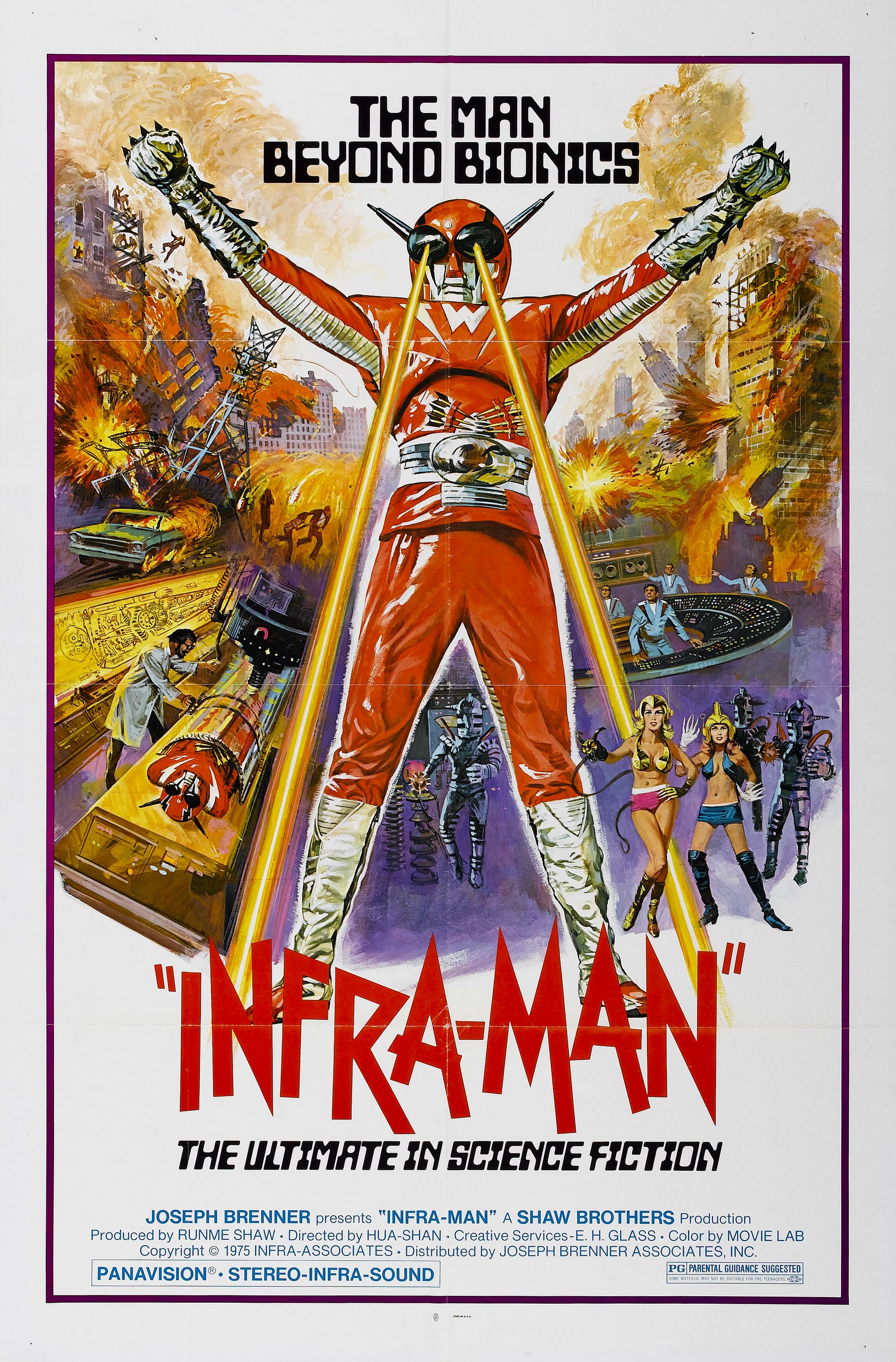
Super Inframan (1975)

I hate Ultraman.

Okay, hate is too strong a word. I am "Passionately Indifferent" to Ultraman. For no apparent reason I cannot bring myself to have an interest in Ultraman. I have watched precisely two episodes of Ultraman, and the second one only because its "monster" was just Godzilla with a frill on his neck.

No, no, it's "Jirass". Totally different monster!
So, yes, despite my love of giant monsters, Ultraman has no draw for me. Also, for no apparent reason, I am not drawn to Martial Arts films in general. Yes, I enjoy the ones I have watched, but as a whole it isn't a genre I seek out.

So, you can see why I was not immediately drawn to the Shaw Brothers-produced, Ultraman-style superhero film Inframan (aka Super Inframan). I had heard great things about it, but it was just not my thing. I had no real desire to track down a copy.

And then, I was talked into buying it. Nerd peer pressure is a very serious problem in our society. Happily, it usually ends in you finding something you didn't even know you were missing.

There is no way to logically explain the opening of this movie, so I'll merely summarize: A van or bus full of school kids is driving along a cliff-side highway when a dragon or pterosaur lands on the road in front of them. This causes an earthquake that cracks open the cliff. The driver is barely able to get all the kids off safely before he and the bus plunge off the cliff. And then a city somewhere erupts in flames.

No, I haven't the faintest clue how the two events are connected.

This series of bizarre catastrophes has, naturally, captured the attention of the Chinese government. Professor Chang (Hsieh Wang) rushes to the futuristic Science Headquarters, where everyone wears a silver jumpsuit, machines go "ping!" regularly, lights flash in sequence, and everything is powered by punch cards. There is dialogue back and forth about "monsters" so possibly we missed a scene where there was more than just the one dragon monster attacking stuff.

A dire report comes in that the extinct volcano "Mount Devil" has erupted and 10,000 people are dead. Then an earthquake hits the base. The Professor orders all scanning equipment to pointed at Mount Devil--and The Professor made the right call. Dirt and rock crumble away from Mount Devil to reveal a totally bitchin' dragon fortress. And then a gargoyle-like dragon appears on the bases's viewscreen, before morphing into a beautiful blonde Chinese woman dressed in what can best be described as viking dragon armor.

With all due apologies to the human race, I'm joining her side.
Our new beautiful overlord (Terry Lieu) introduces herself as Princess Dragon Mom--no, seriously--and advises that humanity must surrender at once or she will destroy us. This is our last warning. The Professor orders somebody to get a printout on Princess Dragon Mom and then asks for Rayma (Danny Lee, aka Li Hsui-Hsien) to be called. Rayma gets the call as he is manfully rescuing a baby from a burning building.

At a cabinet meeting, the presiding official delivers a truly immortal line of dialogue, "Gentlemen, the situation at this time is so serious that it's the worst in human history." It has been determined that the Princess and her monsters are not aliens, but rather prehistoric monsters. The Professor is ordered to find a way to defeat them.

Speak of the devil, at her super villainness lair Princess Dragon Mom is cracking the whip. Literally, her right hand looks like a Graboid tongue and has a long whip coming from its mouth that she uses to summon her creatures: her second-in-command, She-Demon (Dana Shun Shuk Yee), a woman in horned silver armor who has eyes in her palms; Nemesis, a toad-like monster with a drill for a hand; Plant Monster, a green tentacled monster who looks like a melted Oogie Boogie from The Nightmare Before Christmas; Spider Monster, who actually looks like a beetle man; Long-Haired Monster, a laser-powered witch demon with horns and, obviously, lots of long hair; Fire Dragon, a scaly humanoid, horned beast who spits fire; and the Iron Armor Monsters, two creatures with spring-loaded maces for arms and heads. She is also surrounded by her Skeleton Warriors. She announces with glee that it is now their turn to reclaim the Earth.

The Professor has a plan, however. He takes Rayma into his secret laboratory to show him his plans for Infra-Man, an indestructible cyborg soldier. Rayma immediately volunteers to become Infra-Man, despite the professor's warning that he will suffer and possibly die. The Professor picked an unfortunate time to begin the process of turning Rayma into a cyborg, as Princess Dragon Mom decides that Science Headquarters needs to be destroyed and she sends Nemesis and Plant Monster to do it. Nemesis first kidnaps one of the base's personnel, Chu Ming (Wen-wei Lin), and then Plant Monster buries himself under the cement outside the base--and then sends gigantic tendrils up out of the ground to attack the base.Which means the poor expendable bastards have to keep the base's power supply active during the monster's attack, or the Infra-Man process won't be completed and Rayma will die.

The process is a success and Infra-Man demonsstrates hhis power by...wrecking The Professor's lab. Ingrate. The Professor is delighted, though. Infra-Man can sense the monster fight going on and immediately flies to the rescue--whereupon in the vicinity cries out, "Infra-Man! It's Infra-Man! He's here!" Which is pretty impressive, given two minutes ago he was a top-secret project!

Infra-Man's senses allow him to find the Resident Evil-boss weakness of Plant Monster--a heart inside one of the giant tendrils--and blowing it up causes Plant Monster to return to his regular guy-in-a-suit self. Despite having an explosive acid spray and the ability to teleport (!), Plant Monster is laser-beamed to death by Infra-Man. Meanwhile, Princess Dragon Mom has She-Demon brainwash Chu Ming so he can be used against his comrades.

Back at Science Headquarters, The Professor tells Rayma that Infra-Man needs several upgrades to ensure he defeats the Princess and her monsters, leading to the immortal exchange, "For success it's essential that you have Thunderball Fists!" "I can have such a thing?" If you don't love the film before that exchange, you will after you hear that.

Chu Ming returns to the base looking suspiciously zombie-like, but other than The Professor advising he be watched, nobody seems to find anything odd about his return from capture. So Chu Ming is able to use his glowing eyes to overpower a guard and steal the professor's schematics for Infra-Man. Luckily, another guard catches Chu Ming in the act and pursues him--only to be waylaid by Spider Monster and the Skeleton Warriors. The ordinary human holds his own against the Spider Monster and the Skeleton Warriors pretty well until the monster spits a bomb at him that encases him in a web. Rayma shows up with several of the other base personnel in tow--but they're quickly webbed up and Rayma must turn into Infra-Man to take on the fiends.

The Long-Haired Monster shows up, but Infra-Man makes relatively quick work of it. This enrages Spider Monster, who grows to 50 feet in height. Not about to be beat that easily, Infra-Man pulls a Jet Jaguar and also grows to 50 feet in height. The two grapple, but after being tossed into a nearby transformer Spider Monster returns to his normal size and the still-giant Infra-Man stomps him like, well, a bug. Princess Dragon Mom is getting real sick of Infra-Man's shit, but a defect she discovers in the design of Infra-Man's hands could mean victory for the side of Prehistoric Evil.

Of course, unbeknownst to Princess Dragon Mom, Infra-Man's hands have just been upgraded--to Thunderball Fists!

You really can't undervalue how delightful this film is. For those of us entrenched in an age where even fucking Superman has to be a gritty, dark epic this film stands as a candy-colored testament to the fact that once upon a time a film could be about mutant monsters destroying the world with mention of thousands of casualties and still be light-hearted and fun. We have no scenes of Rayma agonizing over how being a super-powered cyborg has kept him from ever having a normal life. Instead, he is delighted at the idea of getting Thunderball firsts!

The film's budget certainly betrays it in a lot of ways. For instance, Spider Monster is clearly wearing shoes. However, they've clearly spread it around as much as possible. With a wide variety of nifty monsters with a wide variety of powers, awesome sets, and even a few exploding miniatures. There's no question that those involved in the film wanted to make it as entertaining as possible. And what entertainment the filmmakers didn't provide on their own comes courtesy of the dubbing. Normally I always recommend watching a film in its original language with subtitles, but the dubbing for this is such a delight.

To describe the film as episodic would be putting it lightly. If I didn't know better, I'd assume it was like Attack of the Super-Monsters and actually a bunch of TV show episodes edited together to make a movie. However, that really just adds to its charm. This film is an excitable 7-year-old describing their idea of what an awesome movie would be, and while that kind of film can sometimes be exhausting--as it was when I first saw Starcrash--there is something immensely endearing about it.

Quite frankly, if you can watch this film and not love it completely, then I don't know if I need your negativity in my life.

I had been working on this review off and on since I picked up the film, but with Sir Run Run Shaw, the film's producer, having passed away on January 7th, 2014, at the ripe old age of 106: I figured now was a great time to finish it up.

Farewell, good sir, as a producer you brought many forms of joy to the world. From Martial arts epics, to Legend of the Seven Golden Vampires, to freaking Blade Runner--you had an indelible impact on the world of film. May flights of Thunderball Fists carry you to your well-earned rest.


Saturday, January 4, 2014

The Terror Within (1989)

So, the world ended.

It came as no great shock: I mean the world had a good run, but we all knew this was coming sooner or later, right?

Well, now all that's left for the measly remnants of the human race to do is to pick ourselves up and cling to the few places on earth not swamped with radiation and hunker down and try to survive as long as we can. It's a great time to try and hone your arts and crafts skills. Didn't you always want to learn how to crochet?

Of course, there are risks. Out in the wastelands there are other survivors who have decided it's better to be dicks to the only other humans on earth. And then there's the dinosaurs. Apparently they felt now was a swell time to come back and reclaim the Earth. Which is kind of awesome, in a way, but also--

What's that? No dinosaurs in this apocalypse? Are sure? I was pretty sure it was dinosaurs this time. Is it aliens? Dragons? Giant scorpions? Oh, please tell me it's at least not zombies because if it is I'll... Mutants, you say? Are we talking full monster mode or just a bunch of bald maniacs? Full on monster, you say? Eh, that's acceptable. I don't feel too cheated by fighting to the death with cool mutants.

I'd still prefer dinosaurs.

We open with two yahoos in military fatigues wandering in the desert by the Gorn Rock™. It is the future and humanity has been wiped out by some form of catastrophe. This pair of goombas is a scouting party, but as you can tell by my lack of interest in their names, they won't be around long. They're also shitty scouts, as they are apparently looking for food and supplies but walk right past a green iguana that's inexplicably wandering around in the desert and kill a rattlesnake instead. I'm pretty sure the iguana has just as much meat on it, if not more, and carries no risk of receiving a venomous bite when you kill it. But maybe one of them had an iguana as a kid and couldn't bear to kill one.

Or, you know, they're incompetent morons. Tomato, to-mah-to.

The two are scouting for supplies for the underground Mojave Lab facility (what the organization they belong to is is never made clear, but it may be a CDC lab based on the signage), and they radio back in to let Sue (Starr Andreeff) and David (Andrew Stevens), who are manning the radios, that they bagged some snake for supper but also spotted some vultures circling and are going to investigate to see if whatever has the vultures interested could still be fit for human consumption. The facility commander, Hal (George Kennedy!) wanders into the radio room as Sue and David are joking about the dire taste of their coffee substitute. After the three discuss the state of their supplies, David broaches the subject of heading for the Rocky Mountain Lab facility but Hal shoots him down, as they have not heard from the Rocky Mountains facility in weeks and it's 1800 miles away. This is clearly a conversation they've had before.

Before they can move on to the next part of this conversation, the two expendable idiots radio in about having run afoul of "gargoyles" before they're cut off in a series of screams and inhuman snarling. Hal orders David and Sue to rescue the other two, if possible. David stops to grab his adorable pit bull, Butch (Butch Stevens, which would suggest the dog actually belongs to Andrew Stevens), as backup. David, Sue, and Butch exit the facility's secret hatch hidden inside a shack on the surface. Hilariously, the hatch is at the top of a ladder and we never see how the hell they get Butch up. We see David and Sue exit the hatch on their own and Butch is suddenly with them in the next scene.

Well, pit bulls are magic.

Linda (Terri Treas) takes over the radio console with Hal to monitor David and Sue's progress. And I am instantly attracted to Linda, as I cannot resist a capable woman--especially not when she's a redhead with green eyes. We get our first hints here that David and Sue are a couple, but it's oddly played as if Hal doesn't know this, which seems unlikely. Hal splits his time between hovering over Linda and hovering over Brett--er, I mean Neil (Tommy Hinkley), one of the facility's repair technicians who is currently griping about the state of their equipment. Neil takes a break from his griping to drink some shine with Parker--er, I mean Andre (John Lafayette), while the two ponder whether it really was gargoyles and whether there's anybody left alive out there.

Sue and David kill time by referring to "the accident" that caused all this. Turns out it was some kind of genetically engineered virus that wiped out most of mankind, except those who received a vaccine. David and Sue find the mutilated bodies of the two scouts--and then the corpses of a group of human survivors, also mutilated. Curiously, while the group is composed of adults and children, the bodies are all males. Linda sees this as an opportunity to study the survivors' corpses and see how they managed to survive outside, with no vaccine. It's a bit unrealistic to expect Sue and David to lug bodies back across rocky desert terrain when the "gargoyles" that killed them are probably still around, so Linda volunteers to go out to study the bodies. Neil and Andre are pressured into accompanying her, as neither one has any interest in going outside.

However, Linda may get something better than an autopsy to find out how non-mutated humans have survived outside. Something lurking around the site of the massacre gets Butch's attention and he runs off after it. It turns out to be a woman (Yvonne Saa, who oddly resembles Gemma Arterton), who is scratched up and fleeing from a snarling, roving POV cam--which Butch helpfully waylays. David manages to almost kill the poor woman with his crossbow, but Sue is able to calm the survivor down and the trio hightail it back to the lab with Butch in tow. Back at the base, Linda starts to work examining the survivor immediately.

Unfortunately, multiple roving POV cams have followed them back to the base and take out the surveillance cams in the shack. David, Neil, and Andre rig up a periscope so they can go and manually assess the threat level and see if the cameras can be replaced--and during the making of the periscope, the film shamelessly copies the exchange about Brett being a parrot for Parker from Alien, which makes no real sense here. Well, they get their answer when a clawed hand wrenches the periscope from David's hands. With no hope of repairing the cameras, they lock the hatch and set up a microphone to monitor the gargoyles' activity.

Things are about to get worse, however. First, Linda determines that the survivor, who we now learn is named Karen, is pregnant. And that pregnancy goes from 3 months along to 7-8 in a single night. And David finally gets through to Rocky Mountain Lab, only to learn they're under gargoyle attack before the transmission cuts off. Hal orders Linda to terminate the pregnancy, but to keep the fetus alive for study if possible.

With Hal and Sue's help, Linda puts Karen under anesthesia. However, in the process of removing the fetus from Karen's womb, Linda discovers the fetus has teeth. And then the fetus--which does, admittedly, look like a gargoyle--rips its way out of Karen's body and escapes into the air vent. With no way to seal the air vents, except manually, the group rigs up a flamethrower and a portable laser. However, they have barely any fuel or battery, so there's little margin for error as they won't get more than three shots before the weapons are useless. David, Andre, and Butch search one level while Hal and Neil search another. Linda and Sue hole up in the control room, in the hopes that the gargoyle won't be able to use them for breeding purposes once it reaches its accelerated maturity.

As is typical of horror movies, the black guy gets it first when the fully mature gargoyle--an admittedly nifty man in a suit creation, though it is poorer for not taking more after the fetus it supposedly matured from--ambushes Andre and slashes his throat. David then gets slapped and clawed around for a bit, but Butch intervenes. Sue heard David's distress over the radio and quickly overpowers Linda and rushes to his level. Poor Butch has met his match with this gargoyle and is severely wounded--though not killed, which earns the film points with this pit bull lover--before the gargoyle takes off after David tries to call Butch with his dog whistle. Neil is ambushed by the gargoyle when he tries to take the elevator and killed. And then the gargoyle grabs Sue after she and David discover Neil's body.

Hal, Linda, and David track the gargoyle down to another level where they interrupt it in the process of raping Sue. Hal uses the laser to distract the beast while Linda and David rescue Sue. Unfortunately for Hal, he's the highest paid actor in the film, so the laser barely tickles the gargoyle. Exit Hal, in the slashing mutant claws of martyrdom.

When Linda examines Sue, she discovers that the poor woman is pregnant. Linda and David assume that it must be David's child, as there is no way the gargoyle could possibly have impregnated her that fast. They make the mistake of telling the still traumatized Sue the good news. Practically the moment Linda and David exit the room, Sue takes a set of surgical scissors to her own belly. The autopsy reveals that, impossibly, the fetus was a gargoyle--though, mercifully, this one didn't survive.

Now David and Linda are on their own. Butch is too weak to help them defend against the gargoyle, and the gargoyles topside are going to keep them from just fleeing the facility. They need to find a way to kill the beast before it kills them--or worse.

Well, this is surprisingly the first Roger Corman-produced film to grace this page. I feel rather ashamed. I will have to add more as soon as possible.

As I imagine I made clear already, this film is an Alien rip-off that showed up about ten years late to the party. It was by no means the first one that Corman produced, but it may be the one that most blatantly copies the plot of Alien. Now, obviously there are enough differences that it may not seem all that blatant. After all, the monsters are raping mutants, not parasitic aliens, and it's set in an underground base in a post-apocalyptic future instead of on a spaceship in the future. But the basic plot and even characters and elements of the story are right out of Ridley Scott's film.

As Corman-produced Alien rip-offs go, this is no Forbidden World. For one thing, it's rather less exploitative and your mileage may vary as to whether that's a mark for or against it. Sure, there's a rape scene--which Forbidden World doesn't really have--but it's played for horror rather than titillation. In fact there's no nudity anywhere in the film, which most certainly cannot be said of Forbidden World. And I have to say that, while I like this film's monster it has nothing on Forbidden World's bizarrely adorable monstrosity. This film also lacks the same sense of fun and sly humor as Forbidden World.

Oh, it tries--like having Linda say, "I'm a doctor, not an engineer"--but it's just ultimately lacking in comparison. So, then, that comparison is probably extremely unfair on my part. On its own terms, The Terror Within is a solid film. It's no classic, but it's an entertaining yarn. The actors all do solid work, even if their characters are mostly one-note. And Butch is adorable.

Ultimately, we go to see movies like this for the monster, though. And the film definitely delivers there. I find the fetuses--largely immobile as they are--to be much more effective than the full-grown gargoyle. However, it's a solid suit so I can see why it has been recycled in other low-budget monster movie efforts since. (Crystal Force and Watchers II, to name a few, as well as The Terror Within II) The only real problem with it is that the separation between the head and the body is glaringly obvious. I believe the creature's designer attempted to conceal this by adding a bunch of loose "flesh" to the beast's neck, but that somehow makes it worse. It looks like the monster is wearing an ascot.

But given we get a lot of good looks at the creature--including a great sequence where it demonstrates its incredibly powerful healing abilities--it holds up extremely well. And boy does it ever go out in a delightfully messy way.

Obviously, the film has its upsides (letting the dog live) and its downsides (being the umpteenth horror movie to kill off the black guy), but overall I'd say it's worth a spin. Don't expect anything on the level of the film it's aping and you won't be disappointed.

This has been part two of the TEOTWAWKI roundtable. We looked at how the world ended at the end of 2013, and now we're looking at the aftermath. Below you will find the other participants' entries. Go and check them out, won't you?

Checkpoint Telstar -- The Book of Eli
Cinemasochist Apocalypse -- Creepozoids
Micro-Brewed reviews -- Six-String Samurai