Friday, February 6, 2015

At The Earth's Core (1976) [Friday Fakeosaurus February]


The trouble with an undertaking like HubrisWeen is that, afterwards, you feel a bit too drained to do much of anything else. November was a wasteland, December just barely got its Christmas review, and it took me a month to write my review of King Kong Escapes and I've seen that movie enough times to have its plot memorized!

Yet, I knew I wanted to challenge myself to do better. And nothing inspires you to step up your game quite like a theme. And February seemed like a perfect month to do a theme for. I briefly considered doing a weekly Blaxploitation review, but I really didn't even need to be told by one of My Black Friends (keep them around as a shield against accusations of racism) that this would be a bad idea for obvious reasons.

Then it hit me: Fakeosaurus February! A month of reviews of movies that contain completely bogus species of dinosaurs! And to further nail down the theme, every review will be scheduled on a Friday!

No concerns of racism necessary! Well, at least not from me--I make no promises for the movies.

Speaking of racism, have I featured a White Savior movie on this site? No? Well, here, let's tackle an Edgar Rice Burroughs adaptation!

In this case, we're tackling the first Burroughs book I ever read and the second of three Burroughs adaptations that Amicus Productions churned out in the mid-1970s. Amicus was a competitor to Hammer Studios and if you ever felt that the budget on any of Hammer's productions were threadbare, you haven't seen an Amicus film.

When Hammer wanted dinosaurs, they hired Ray Harryhausen and Jim Danforth & David Allen. When Amicus wanted dinosaurs they hired...um. Uhhh... Well, they hired someone, but I'm not entirely sure that someone wants to be remembered.

The film begins in the early 1910s, with eccentric inventor Dr. Abner Perry (Peter Cushing! And he's doing an oddly foppish accent in this film) and his financier and former student David Innes (Doug McClure!) unveiling the Iron Mole for a cheering crowd. It's a huge, tube-shaped  machine with a drill on the front. The Iron Mole is going for a test run, where it will burrow through the Welsh Hills, racing against a team of horses topside.

Of course, things almost immediately go pear shaped. The machine continues digging straight down and refuses to right itself to horizontal. And so the pair of explorers find themselves drilling through the mantle and are quickly overcome by the great heat, losing consciousness. The Iron Mole continues on and the two are soon woken by cold, as the machine has hit a huge layer of ice in the outer core. However, they're able to stabilize their descent and reverse it, finally--singing merrily as they go.

Well, until they find themselves in an underground lake. And then they land in some kind of forest, right before the Iron Mole's power goes dead. Perry observes it must have been a short caused by the water, as he hadn't prepared the machine for water. David decides to make the best of their situation and go exploring. Perry grabs his trusty umbrella and follows, into the bizarre forest full of prehistoric vegetation and giant mushrooms, and a pinkish purple sky. They both take much too long to figure out where they are, all things considered--it takes Perry checking his compass to realize they're not on Earth but under it.

And then the "dinosaur" shows up. (Mind you, we are 14 minutes in to the film and our first monster has already appeared. You can't accuse this film of wasting time, which is not exactly true of the other Amicus Burroughs films)

Now, in my distant memories of the book I seem to recall the creature they first encounter being described as being like an upright alligator. The monster that the film gives us sort of has a body like an upright lizard or alligator---albeit much more simplistically detailed--but its head is what you would get if Sam the Eagle were hit with Gamma radiation and Hulked out.

"You weirdos shouldn't make me angry. You wouldn't like me when I'm angry."
Whatever the Fakeosaurus is supposed to be is not mentioned, probably because there was no real-world equivalent the filmmakers could pass it off as. How big is the Fakeosaurus? Hell if I know. The rear-projected shots of Perry and David fleeing from the creature suggest it is maybe 30 feet tall at minimum, but soon they'll be interacting with full-sized props that suggest the creature is around 12 feet tall.

David leaves his cigar lit as he flees and Perry tries to shoo the creature with his umbrella, before David tells Perry to climb up a tree while he...tries to find a weapon, I guess. Naturally, this puts Perry at mouth height to the beast. Which, again, seems very large in the shots where it's menacing Perry but the full-size prop leg that David hits suggests the creature is barely twice his height. At any rate, David distracts the monster from Perry--whose poor umbrella was not much help in fending the fiend off--and then David manages to run straight into quicksand. The Fakeosaurus should have an easy meal, except it is suddenly driven off by spears and David is hauled out of the bog.

It's not exactly a rescue. See, their saviors are a bunch of aggressive humanoids in alligator-skin vests outfits, with pig-like noses and cone-shaped heads that all have thinning hair. No doubt they're touchy about it. The humanoids only communicate in electronically distorted voices and they promptly chain Perry and David to the rest of their human captives. I might add that fully a third of the humans we see in the film are wearing awful, curly "Annie" wigs. Even the black people.

"Look, we had to either cut wigs or catering from the budget. I'm sure you'll agree we made the right choice."
"There was catering?"
"...Sure."
And yes, there are black people, which makes this film sadly more diverse than it would be if it was shot in 2015.

There's some possibly intentionally vaguely racist dialogue where Perry observes the humans appear to be intellectually superior to their non-human captors, yet the pig-faces are the "Master Race." And then David is lashed by one of their captors and says, "I'll remember him, Doc, but they all look the same."

The group is quickly set to march by their captors--completely oblivious to another barely glimpsed Fakeosaurus that is watching them from the trees. Amongst their fellow captives, David naturally quickly notices and makes the acquaintance of Dia (Caroline Munro!), seeing as how he's the "dashing" hero and she's gorgeous.

Yes, I would punch dinosaurs in the face for her.
Luckily, Dia and her compatriots speak English (?) so Dia is able to tell David that the shady-looking creep that keeps looking at him is Hooja the Sly One (Sean Lynch) and is not to be trusted. When David wonders if it's ever night since his watch says it's been two days of marching, Perry explains that they are in an immense cave with light provided by magma some 20 miles above them so there can't be any night. When one of their captors steals David's watch, which belonged to his father, he asks Dia what they are. "Sagoths," she explains, "soldiers of the Mahars." She further explains that, "Mahars rule Pellucidar. They are taking us to be slaves in their city."

And then Hooja the Sly One decides right then to grab Dia and David slugs him good. For some reason, everyone--including Dia and the Sahgoths--then stares at David expectantly, and then everyone turns their backs on him before the Sagoths march them forward. David doesn't have much time to ponder why everyone is giving him the cold shoulder before the captive leading the chain gang is suddenly set upon by the Fakeosaurus that was watching from the trees.

This promptly turns him into a truly regrettable doll puppet as the Fakeosauruus crams him into its mouth, What is this Fakeosaurus? Well, um...it's...

"Mmm. Hobbit!"
Basically, it appears somebody took an Uintatherium (a prehistoric rhino, which has been featured in a film on here before) and made it a biped with hands. So, strictly speaking it's not a dinosaur but I'm still calling it a Fakeosaurus because it's, well, fake,

A second Fakeosaurus of the same species then arrives to fight the first after the Sagoths cut its victim loose. The two grapple while humans and Sagoth cower in safety. Finally, the challenger fatally gores his opponent and makes off with the prize of the poor captive human. Onward the chain gang marches.
"You do realize there are, like, over a dozen equally vulnerable prisoners over there you could eat instead of fighting me for this one?"
"Up yours, Carl!"
They soon arrive at the City of the Mahars, which is an elaborate castle-like structure when seen from afar, but the entrance and interior are just a system of caves. As they are ushered into the city, Perry observes of the Sagoths, "They're so excitable, like all foreigners." David soon notices that Dia has disappeared and tries to get some answers from one of their compatriots about why he's getting the cold shoulder. Hooja the Sly One has somehow absconded with Dia: it seems that David claimed Dia as his own by besting Hooja the Sly One, but he neither claimed her nor released her from his claim and thus committed a heinous faux pas. No man may claim her until they have bested David now, and Dia was already fleeing from Jubal the Ugly One who has the strength of many men and wants her for his own when the Sagoths captured her. Presumably Hooja the Sly One intends to bring her to Jubal the ugly One.

The agenda of Goomba the Moderately Handsome One is not mentioned.

Oh, and Dia is actually a princess, but you knew that already. She's incredibly proud and unlikely to forgive David even if he does find her again. Whoops.

Perry, for his part, is more fascinated by the fact that the Mahars are able to somehow channel the flow of lava as they see fit. And he's even more amazed when they are ushered into a large chamber to serve as audience for the Mahars, for the Mahars turn out to be a variety of man-sized Rhamphorynchus!

Now, I'm gonna go ahead and call the Mahars yet another Fakeosaurus here. Yes, as I have previously observed, Rhamphorynchus is a real pterosaur (and my favorite). And Perry identifies them as Rhamphorynchus, which they also were in the novel--but nobody told the special effects department that, apparently. So instead the Mahars are just beaked dragon-looking creatures. Nobody would actually look at them and go, "A Rhamphorynchus, of the Middle Jurassic Period!"

The white one is the leader, because of course it is.
And I will say that the Mahars are, while nothing special, not horribly bad suits--except for one glaring miscalculation. You know that frill that Kermit the Frog has around his "collar"? Well, some demented suit designer decided that the Mahars should have them as well. Because when you're making a monster, you definitely want it to remind people of a Muppet.

"Hi ho, Kermit the Mahar, here!"
As in the novel the Mahars are at least partially telepathic and have the power of mesmerism, which they use to control the Sagoths. However, the film never addresses if they are all female, as in the novel. The Mahars split their captives into groups, with Perry being sent to the Mahar library and David is sent to perform physical labor to keep the channeled lava in check. Perry quickly discerns that the Mahars have some secret that may serve to destroy them if he finds it, David, meanwhile, causes a brief slave revolt and uses it as a distraction so he can escape the city.

Once outside he finds an unattended campfire and helps himself to the meat being roasted over it. the owner of the campfire returns and attacks David and the two fall into a nearby cave in their struggle. A cave that, bizarrely, serves as the home of a tentacled carnivorous plant that makes vocalizations like the THX logo. (Why the plant would want to live in a cave instead of somewhere food would actuallly be likely to happen across it, is beyond me) The two fight,oblivious, until David's foe is grabbed by the plant. David rescues his companion by cutting the tentacles holding him--which apparently kills the plant!

The other man introduces himself as Ra (Cy Grant) and expresses amazement that David escaped from the Mahar city. When David asks why Ra's people and all the other tribes haven't risen up against the Mahars, Ra explains that it isn't that simple. And he leads David to the Mahar's grotto to show him why. Thus David gets to watch, helpless and horrified, as several women prisoners are placed in a pit ringed with fire, and then the Mahars swoop down and devour them.

Now, it's called a "grotto" despite no water being present probably because, in the original novel, it was a grotto. A Mahar would choose one woman at a time and mesmerize her into walking into the water with it, then resurface--and each time they resurfaced a part of the woman was missing until only the Mahar surfaced. It was creepy as Hell. This sequence? Yeah, not so much. The lead Mahar hypnotizes one woman and carries her off, but the others aren't even mesmerized into not running away!

At any rate, David's White Savior button has been pushed and he declares it is time to destroy the Mahars. Well, after he manages to fall into the "grotto" and then has to sneak by the Mahars napping off their meal. David decides he will go back into the Mahar city to rescue his compatriots and tells Ra to go back to his village, but Ra refuses to let David go back alone. "We've just doubled our strength," David quips. And all without finding two wolves named Kurt!

Sorry, that joke only makes sense if you've seen Tarkan vs. The Vikings.

Naturally, the two are promptly captured and brought to the Mahar audience chamber again. While all the slaves--including Perry, who does a superbly hilarious "Hi, it's me!" wave at David--are made to watch, Ra is chained to a sacrificial pole and the Sagoths toss David a spear. A portcullis rises and out of it roars...

...the cutest Fakeosaurus you will ever see. It might be supposed to be something like Inostrancevia, a mammal-like reptile of the therapsid order and thus not really a dinosaur, but then almost none of the Fakeosauruses in this film have been what you would classify as dinosaurs and it's definitely a Fakeosaurus. It's also adorable. (And it would reappear, though barely glimpsed, in The People That Time Forgot the next year)

"I was hiding behind your portcullis because I love you!"
Well, David is not moved by its adorableness. Following Ra's advice he spears the poor thing in the ear after a bit of dodging a rear projection of the guy in the monster suit and a full-scale head that, I'm sure you're shocked to hear, doesn't match the scale or proportions of the suit. The poor thing seems very confused about being stabbed, since it didn't appear to actually be trying to eat David but rather acted like an overly excited puppy greeting a new guest, and then it falls over either dead or exhausted.

Well, the Mahars are sore losers and one swoops down at David, only for Ra to break his chains and use them to strangle the beast to death. Great job, Mahar #3: you've just shown the hairless apes that you are not only mortal, but easily killed. Not that the other Mahars do anything to stop it. And just like that, the rebellion begins. The Sagoths are overwhelmed and almost all the slaves escape, save those trapped by the Mahar fire curtains. David leads Perry through the caves, during which Perry cries out a line that is hilariously easy to take out of context: "I have a firm grip upon your trousers, David!" Perry also insists on showing David the Mahar's secret before they leave: the Mahar's eggs are kept in a chamber that is heated by lava. Destroying the chamber would wipe the Mahars out.

David and Perry find their way out of the city and immediately stumble across Dia, who is being pursued by Hooja the Sly One. Hooja the Sly One catches Dia and threatens to spear her if David comes closer, but luckily the silliest Fakeosaur of all intervenes: a fire-breathing toad monster! Well, it has a tail so that makes it actually a salamander, which I'd think was clever if I had any inkling that the filmmakers were intentionally making a joke. And amusingly enough, this weird critter actually is in the book, though there it's just described as a literal dragon.

A gritty, live-action reboot of Pokemon was a really strange idea.
Hooja the Sly One flees and David rushes to Dia's side to chucks rocks at the Fire-breathing Fakeosaurus. However, they're only saved from certain flamebroiling by Perry shooting the beast with arrows using a bow he whipped up in a matter of seconds somehow. The creature falls off its perch and when it hits the ground it explodes in a big fireball, as you do,

Dia proves incredibly quick to forgive David after puts the moves on her, but she warns that Hooja the Sly One will be leading Jubal the Ugly One to them. And, indeed, the trio quickly run into Jubal the Ugly One (Michael Crane) before they've gone far. David refuses to run, however. For Jubal the Ugly One is merely practice. Soon he's going to have to unite all the tribes of Pellucidar and take down the Mahars.

All in a day's work for a White Savior.

There's no question that Amicus didn't have the best production values when it came to their Edgar Rice Burroughs films. The Land That Time Forgot probably had the best effects budget, and its dinosaurs were all obvious puppets or stiff full-size props. Meanwhile, almost all of the creatures in this film are men in suits that wouldn't pass muster at Toho Studios and awkward full-scale props. You really need to pull out all the stops with the effects for films like these, but the sad thing is that Amicus probably did.

Yet, while the effects may not be breathtaking or convincing--for instance, the bit where a Mahar tries to strangle David with its wings but somehow stays airborne--there's a certain charm to them that you can't help but love. And the fact that they still pushed forward with stocking a movie full of dinosaurs when they could have had hardly any and saved the effects budget for other things is very admirable. Sometimes quantity is way better than quality.

As for the story, it definitely takes a few divergences from the source novel that are not always the right choice. (Like its ending, which I won't spoil here) Some of these are obviously due to budget and an attempt to reach a wider audience, but not all of them. However, it's faithful in spirit to the original novel and what truly matters is that it's a fun adventure romp--and the film is definitely that. The plot may be something you've definitely seen before, but there's something to be said for the familiar in fiction.

The cast is also a delight and there's nary a terrible performance to be found. Peter Cushing is as delightful as he always is; Caroline Munro makes Dia an interesting character in spite of being only asked to basically be present and look gorgeous; and Doug McClure, while certainly no master thespian, makes for a very enjoyable pulp hero. The supporting cast is also good at what they do. Even if most of them are forced to act with some of the worst wigs and fake beards the costume department could find.

There's just something pleasing about this kind of film. I hate to pull the old nostalgic, "kids these days" crap, but there's just a certain charm to movies like these that today's B-Movies don't capture. Since so few people do practical effects, you just don't encounter films with charmingly terrible practical effects anymore--and terrible CGI doesn't have the same appeal. Hell, when a rare B-Movie comes along that does use practical effects, they often make the effects in this film look like Stan Winston and Rick Baker. Somehow that's not as charming as you would think.

It's also nice that this film is just recent enough to not be irredeemably sexist or racist, even though it's based on Edgar Rice Burroughs. Sure, I've long ago had to inure myself against such things as a B-Movie fan, but it's nice to not have to utilize that self-defense system. This is a movie I'd show my son without worrying overmuch about it warping his view of the world.

If you're looking for a classic, At The Earth's Core is not it. But if you want a fun matinee flick full of ridiculous Fakeosauruses, then this is a wonderful choice. Plus, too few movies contain Peter Cushing declaring to a telepathic pterosaur, "You can't mesmerize me: I'm British!"

Saturday, January 31, 2015

King Kong Escapes (1967)

Before I settled on Godzilla vs. Space Godzilla, the movie I had considered as a Christmas review was King Kong Escapes. I had been considering making a tradition of reviewing non-Christmas Rankin & Bass films--especially those involving giant monsters. After all, The Last Dinosaur was my Christmas review in 2013. The only problem was that, well, after this film (which Rankin & Bass co-produced with Toho studios, more on that in a bit) the only other film that fits that criteria is The Bermuda Depths. And unlike this film and The Last Dinosaur, it doesn't have lengthy sequences set in the Arctic.

However, while I decided to put the film aside for another time, something happened that made me decide to go ahead and review it as soon as I was able: on December 26th, 2014, Rhodes Reason passed away.

Who was Rhodes Reason, you ask? Well, aside from being a prolific character actor--including playing a Space Roman gladiator in an episode of Star Trek--he was the token gaijin "hero" of King Kong Escapes. And yes, I did mean the sarcasti-quote marks.

There's also the fact that this film sort of fits with the theme of Checkpoint Telstar's "Month of AlloSundays." There isn't a true Allosaurus in it, but there sort of is one. But then, I'm not posting this on a Sunday.

We begin with a United Nations submarine tooling along the bottom of the Pacific Ocean, purportedly on an oil prospecting mission. On board, we are introduced to Lt. Susan Watson (Linda Miller, whose voice has been dubbed over by a banshee with a sore throat), the ship's nurse. She gains some likability points by responding to a leering sailor's comments about wishing he was running a fever with a threat of dosing him with castor oil. She says it playfully, sure, but I choose to believe she fully intends to make the guy vomit his guts out if he doesn't behave himself.

Watson is, of course, bringing drinks to the Captain's Cabin. Inside, the skipper, Commander Carl Nelson (the late Rhodes reason) is showing off some maps and drawings of gorillas to his first mate, Lt. Commander Jiro Nomura (Akira Takarada!). Watson commets that she doesn't get their obsession with gorillas. "I think they're dull," she weirdly observes. Nomura smirks and replies, "Well this one's sixty feet tall. What do you think of him?"

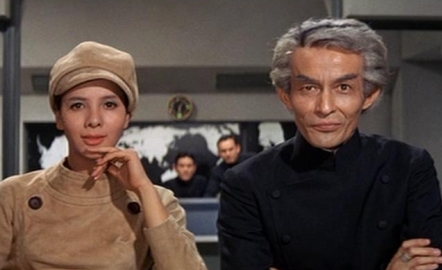
Left to right: Jiro "The Actual Hero" Nomura, Susan "Fay Wray" Watson, and Carl "Designated Hero" Nelson.
You see, Cmdr. Nelson is a bit obsessed with the legend of a giant gorilla called "Kong," who is supposed to live on one of the islands in the chain they're currently surveying. That island is Mondo. Yes, Mondo. I suspect it is next to Hepcat Reef and Daddio Trench. However, as much as Nelson wants to go look at Mondo and hunt a giant gorilla, it's not part of the mission. So he'll have to amuse himself with drawings of Kong and photos of giant steps on a nearby island that clearly were meant for something much larger than a human to use. (Forget about the steps, they won't come up again)

Someone else has something more useful in mind for those drawings of Kong that Nelson has. Somewhere in the Arctic, at a secret base, the fiendish Dr. Who (Eisei Amamoto!) has somehow obtained copies of those drawings and used them as the basis for a gigantic robot gorilla: Mechani-Kong!


Now, you might think that just having a giant robot gorilla is a goal in and of itself. I mean, that's freaking awesome, right? But no, Dr. Who--no, not that Doctor Who--has built Mechani-Kong for a specific purpose. See, Dr. Who's extravagant services have been hired by one Madame Piranha* (Mie Hama!), the representative of an unnamed country with designs on becoming a global superpower--who will later refer to herself as, "Your typical Oriental mata-hari," to my Korean girlfriend's eternal delight.

[*Madame Piranha is just "Madame X" in the English version, but "Madame Piranha" is a way  cooler name so I'm using it]

Keep your Timelords, this is the only Dr. Who that matters to me!
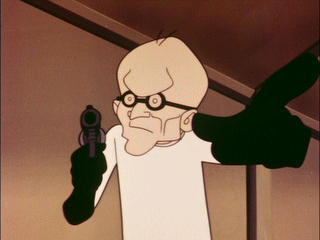
Oh, and a brief aside for anyone who insists on referring to the villain as "Dr. Hu" as an attempt to differentiate him from the even then popular British sci-fi character: you're wrong. The character originated in the cartoon where he was a short, bald-headed white guy named Dr. Who. I have no idea if the name was a coincidence or deliberate (and bizarre) rip-off, but the name is the same.

Yeah, I'll still stick with the Japanese Dr. Who.
Anyways, Madame Piranha has come to Dr. Who's base to oversee his operations, but it's not the robot she wants. See, Dr. Who built the robot to mine the mysterious Element X, which is a very rare and powerful element that can be found in hugely rich veins all around the location of his base. Trouble is, Element X's massive power is a result of it being so radioactive as to be immediately lethal to any human mining crew. However, a giant robot gorilla with a grenade belt (!) should have no problem digging it out. And so, under Piranha's watchful gaze, Dr. Who sends Mechani-Kong out on its maidenvoyage to dig up Element X.

Trouble is, Dr. Who didn't take into account the magnetic properties of Element X. So the instant Mechani-Kong uncovers the stuff, the robot slumps over uselessly. A hugely embarrassed Dr. Who swears to an unimpressed Piranha that he will find a way to get her the Element X she so desires.

And don't ask me how Dr. Who retrieves Mechani-Kong from the dig site, but he'll later have the robot back to full function and it's clearly not just a duplicate of the original.

Meanwhile, things also go "wrong" for Cmdr. Nelson when an underwater rockslide smashes the propellor of the submarine. The sub conveniently must anchor in the bay of Mondo Island for repairs, so naturally Nelson seizes the opportunity to go ashore and explore Mondo--and he brings Nomura and Watson along with him in the sub's groovy hovercar.

Strangely, after they park the car, Nelson observes that the island seems deserted in a way that implies he has been to the island before. This may be a line that was messed up in translation because nothing before or after suggests this, as we shall soon see. There is, however, one elderly islander (Ikio Sawamura, who can be seen playing virtually any old man character in an Ishiro Honda film) who shouts a warning at them from afar that they are trespassing in the domain of Kong. Nelson, who stragely understands the native's language, catches the word "Wong" being used as a prefix to "Kong." Apparently, "Wong" means "King."

Honestly, it's hard to say if "King Kong" or 'Wong Kong" sounds sillier.

The islander then disappears from view, but Nelson wants to chase after him. So Nomura agrees to follow him--carrying their only rifle--and they tell Watson to wait by the car. "You'll be safer here," Nomura tells her.

I really hope that at some point later on, off screen, Watson beat both of them over the head with a thick and heavy book because the second they leave, a hungry Gorosaurus shows up.

Gorosaurus is what I was referring to when I said the film sort of features an Allosaurus. Athough the dinosaur is not named in this film--he gets his name in Destroy All Monsters--this is his debut. He's one of my favorite monsters in the Godzilla lexicon, even though he is basically nothing but an Allosaurus crossed with a T-Rex and Ray Milland, and then blown up to 60 feet tall. For one, I love his design--which is easily the greatest use of a guy in a suit as a dinosaur prior to the non-CGI Raptors in Jurassic Park--and his personality is way cooler than you would ever expect from a dinosaur designed as "T-Rex stand-in."

The majestic Ray Millandosaurus.
Gorosaurus spies Watson and promptly zeroes in for the kill. Watson's screams alert Nelson and Nomura, but they also wake up something in a nearby cave. The mighty Ko--oh my God.

*deep breath*

Eiji Tsuburaya's first attempt at a King Kong suit in King Kong vs. Godzilla is rather notorious for being terrible. Its fur is the wrong color, it looks rather like it was stored in a damp basement for a few years, it's shaped nothing like a gorilla (even when they sometimes give it "arm extensions"), and its face is stuff and inexpressive. It's overall a terrible gorilla suit, even compared to what Hollywood was using at the time.

This suit is worse.

Oh, it actually has the right proportions--more or less--and it is closer to the actual fur color of a gorilla, but everything else is worse. Words can't even fully describe its goofiness.

"Ha! That's great. Now, seriously, guys, where's the Kong suit?"
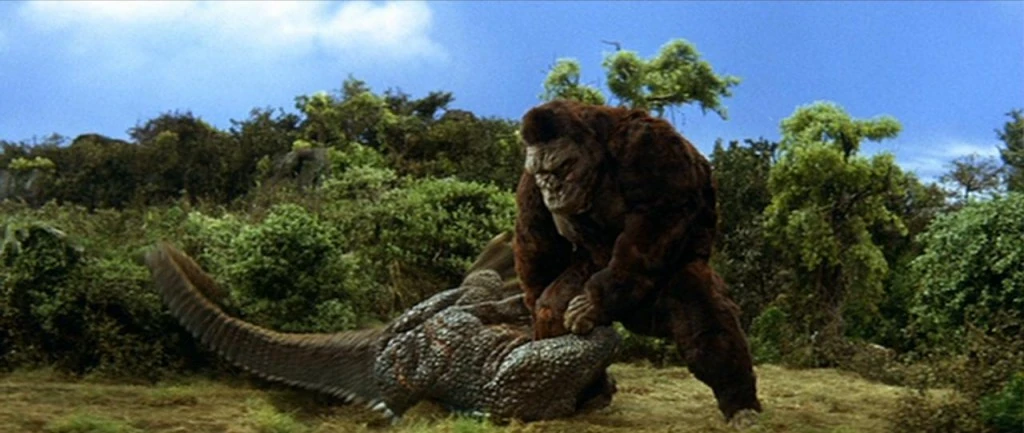
At any rate, the goofy Kong makes his way to the clearing where Watson is being menaced by Gorosaurus. In case you hadn't figured it out, you're about to be treated to a baltant recreation of one of film's greatest special effects sequences--the Kong vs. T-Rex fight from the original King Kong. It's...somewhat less impressive than the original.

"Ow! Bad dinosaur! BAD!"
Kong picks up Watson, gives her the ol' Fay Wray eyes and then puts her in the crook of a nearby tree for safety while he challenges Gorosaurus--and promptly gets walloped by Gorosaurus's trademark kangaroo kick, which is really the only thing that keeps this sequence from being only a pale imitation of the real deal. Kong is resilient, though, and ultimately pounds his saurian foe into submission. Kong then takes Watson from the tree to make affectionate faces at her--and the puppet for expressive close-ups may actually be worse than the suit--while Watson tells him to put her down via repeating herself slowly like a typical white American trying to communicate with a speaker of another language and "sign language."

Somehow this works and she runs off to rejoin Nelson and Nomura. Kong objects, but since Gorosaurus is not dead he has to pause his pursuit to break the dinosaur's jaw--which causes Gorosaurus to vomit up soap bubbles instead of, you know, blood. Meanwhile, the three heroes find their hovercar waylaid by a silly sea serpent. Kong luckily arrives to throw a rock at its head--which somehow only annoys it--and then proceed to wrestle with it.

"It's okay, I saw Bela Lugosi do this once."
The three make it to the sub, but then Kong--having extricated himself from the serpent's coils--begins shaking the sub violently in the hopes of somehow dislodging Watson. Knowing she's the only one who can stop the sub from being torn apart, Watson goes topside to reason with Kong. Kong, naturally, tries to carry her off. However, he remarkably takes the hint when she jumps out of his hand and returns her to the sub before forlornly returning to his home. Presumably he's going to put on his giant fedora and go rant on Men's Rights message boards.

Nelson wastes no time in forgetting his actual mission and returning to the United Nations Building in New York to rave to a bunch of reporters about how awesome Mondo Island is and how Kong totally exists. His goal is to get another expedition to Mondo funded. One of the reporters is actually Madame Piranha and she has a radio link to Dr. Who. After Nelson explains how Watson was able to soothe and almost commuicate with Kong, Piranha seaks away to tell Dr. Who that Watson is the key to controlling Kong.

See, Dr. Who has decided that the best way to save face after the failure of his Kong robot is to kindap the real Kong and make him dig out Element X. How Dr. Who can be certain the radiation wouldn't be just as lethal to Kong as any other animal is never addressed, but we can safely assume the answer is "he's a giant monster."

So, Dr. Who's ships and helicopters arrive at Mondon Island ahead of Nelson's new expedition. Kong is knocked out with ether bombs and chained up to the helicopters. The islander runs up to Dr. Who and his landing party to protest, but in the greatest part of the film Dr. Who just responds, "Yes, Kong's mine now," before pulling a gun and casually putting three bullets into the islander, and then turning back to the task of wrangling Kong. So Kong is airlifted off the island and secured in the cargo hold of one of Dr. Who's ships.

Thus, the island is bereft of Kong when Nelson's expedition arrives. There's evidence of the capture, but that means very little. Well, until Watson fnds the dying islander. The man tells Nelson what he saw before expiring, and Nelson explains to Watson and Nomura that he said "an Oriental skeleton, with eyes like a gutter rat" took Kong away. (No, I have no idea why the islander would have a concept of "Oriental" or "gutter rat", but maybe Nelson is paraphrasing) At any rate, Nelson knows exactly who is responsble: "My old friend, that International Judas: Doctor Who."

My girlfriend, around this point, suggested that Nelson and Dr. Who are rivals because they're ex-lovers. I gotta say, it checks out--and makes the movie more entertaining.

On their way back to the UN, a sea plane approaches the sub and advises that they have orders to take Nelson, Nomura, and Watson to Tokyo. Of course, the plane is actually staffed by Dr. Who's henchmen--and Nomura picks up on the fact that they're not Japanese first, but the trio decides to see where this is leading. The answer, of course, being to the Arctic.

There, we discover Dr. Who has hypnotized Kong and fitted him with a headset so that Kong can be monitored and receive orders at the same time. He kidnapped Nelson, Watson, and Nomura as insurance--seeing as how Watson has sch value to Kong and they're the only living King Kong experts. Such as they are. Bet he's wishing he hadn't killed the guy who spent decades of his life on the same island as Kong, huh?

Kong is sent to work, and seems to be making far more progress in digging out Element X than MechaniKong. Dr. Who's gamble seems to be paying off at first since clearly Kong is immune to the radiation that Elerment X gives off...but it turns out that the hypnotism Dr. Who employs is not. So Kong snaps out of it, throws off the headset and charges back down the tunnel to the base--with the uge metal door slamming shut to trap him in the tunnel ony just in time. Well, now Dr. Who really needs Watson's help, but naturally none of our heroes wants to help him.

So Dr. Who locks Nomura and Watson in a freezing cell and then plays chess with Nelson. Here's our first instance of Nelson being a worthless hero while Nomura tries valiantly to keep Watson from freezing to death. Oh, and when Dr. Who is called away, Nelson is summoned to Piranha's quarters and begins putting the moves on her over drinks. You know, while his subordinates are freezing to death. He does, eventually, get Watson and Nomura out of the cell, but he sure took his time about it.

Of course, Dr. Who finds himself in a bit of a jam when Kong finally tears apart the huge steel door and then digs himself out of the tunnel and goes bounding off into the Arctic wilderness. Dr. Who sends MechaniKong after the real deal, but Dr. Who not only forgot to shield the robot's "brain" with lead, but neglected to make its body watertight. So when Kong dives into the freezing Arctic waters and swims for it, his robot duplicate can't follow.

Dr. Who barges into Madame Piranha's quarters, completely unbothered by the fact that all of his prisoners are calmly hanging out in there with her unrestrained. He just wants his captives to tell him how strong a swimmer Kong is. Somehow Nomura and Nelson both know that Kong regularly swims back and forth between islands in the same chain as Mondo-even though there is no way they could know that--so Dr. Who knows for certain that Kong will escape this time. Hey, the title didn't lie!

Dr. Who locks his prisoners up again for the journey to follow Kong, who has--naturally--made a beeline for Tokyo. Dr. Who intends to send MechaniKong into the cty to subdue Kong, and he doesn't care about any collateral damage. However, Madame Piranha is not so ruthless as her business partner. Not only would having her country's involvement in the destruction of major city cause an international incident that they can scarce afford to handle without Element X backing them up, but she just doesn't want to see millions get killed by the battle beween two 60-foot monsters in the middle of a crowded city.

So Piranha lets Nomura, Watson, and Nelson escape to warn the authorities and hopefully get Kong under control before the beast causes any damage or gets killed. Unfortunately, our heroes arrive in Tokyo only slightly ahead of Dr. Who. Nelson and Nomura convince the Japanese Defense Force not to attack Kong and Watson calms the beast, but then MechaniKong smashes through a building--intent on reclaiming Kong via the same hypnotic device Dr. Who used before, now installed on its head. Nomura uses a rifle to take out the hypnotic device, but MechaniKong just grabs Watson and now the battle is on.

Not this battle, sadly, but almost as awesome.
I've spoken of King Kong Escapes previously, in my review of Godzilla vs. The Sea Monster. The film started life as a result of a deal Rankin & Bass struck to produce a King Kong cartoon, provided they also produced a eature film along with it. Rankin & Bass turned to Toho, knowing they could produce a feature film for a lower cost than most Amerian studios--and also possibly the fact Toho had already bought the rights to Kong in order to make King Kong vs. Godzilla probably made rights negotiations easier.

I'm going to guess the script Toho first sowed to Rankin & Bass that wuld become Godzilla vs. The Sea Monster probably was actually one they'd been kicking around prior to the partnership. I mean, it's hard to believe Toho had zero plans to reuse Kong after the amount of money they dropped for his rights. The appearance of Mothra in the screenplay and Kong gaining strength from electricity both point towards the film being a sequel to King Kong vs. Godzilla instead of a stand-alone feature.

Regardless, I'm thankful that Rankin & Bass refused the script and it became a Godzilla vehicle instead because that means we got two awesome movies instead of one.

King Kong Escapes is a delightful film, indeed. It's aimed at a younger audience, but doesn't adopt a condescending attitude like many kids' films. Watching it as an adult is therefore not a chore, unless you're some kind of monster who dislikes guys in rubber suits beating on each other on miniature sets. Of course, while the film is perfect for a young audience in most respects, parents should be cautioned: while the defeat of Gorosaurus is completely bloodless (unlike its inspiration), both Madame Piranha and Dr. Who meet violent, bloody ends. Usually creature violence is considered less horrifying than human violence, but this film is quite the opposite. There's no Disney-esque move of chucking the villain off a cliff: Dr. Who dies pinned beneath heavy machinery, coughing up blood, and then is drowned by a few thousand gallons of sea water.

Aside from that, there's really nothing beyond a bit of typical late 60s chauvinism to make it unsuitable for kids. Well, that and the bizarre bit of racism that has Nomura doing all the actual heroics and sets up a relationship between him and Watson, only for Watson to run to Nelson's arms at the end! Nelson has more chemistry with Dr. Who than he does with Watson, but I'm guessing someone was afraid that American audiences would be furious at a Japanese man being involved with a white woman. (The inverse would, naturally, not have been a big deal at all--for reasons of racist logic that I won't rant about here) Of course, this being a kaiju film we are spared them kissing*, so feel free to interpret the embrace as Watson receiving comfort from a father figure, while she really loves Nomura.

[*For some reason, perhaps a cultural one, kaiju eiga never have any kissing in them that I've seen, no matter how heavily a romance is implied between two characters. The only exception that I know of being Invasion of Astro-Monster, where we briefly see Nick Adams and Kumi Mizuno kissing. (Which proves my other point above, sort of) This is why it amuses me that people interpret the ending of Pacific Rim as Mako and Raleigh not being romantically involved. By kaiju eiga tradition, they were practically necking]

"Enough about the human characters," you say, "what about the monster action?" Well, as I've said the King Kong suit is the worst ape suit Toho ever produced and the sea serpent, while well crafted, is so obviously inanimate that poor Haruo Nakajima (who else?) in the Kong suit is forced to wrap it around himself in order to "fight" it. However, MechaniKong is the second most awesome mechanical doppelganger that Toho would deliver in the Showa era--and Gorosaurus is by far the best man in a suit therapod put to film, in my opinion. The fight scenes are also well-choreographed. The Gorosaurus fight could easily have been nothing but a sad recreation of the original Kong vs. T-Rex fight, but the addition of Gorosaurus's kangaroo kick gives it a bit more life.

The real standout, though, is the final fight in Tokyo. Rather than the expected wrestling match, it becomes an odd game of "King of the Hill" as MechaniKong climbs up Tokyo Tower with Watson in one hand while Kong gives pursuit. The Tokyo Tower "miniature" (I say because clearly it's a massive set, only small by comparison to the real thing) is wonderfully built and the fight is actually pretty suspenseful.

I also appreciate that the relationship between Kong and Watson is more one of friendship and admiration than the traditional ape lust. Aside from Nelson's casually sexist joke about Kong being tamed by her because she's a looker, there's never really a hint that the ape thinks of her as anything but a tiny pet.

In the end, King Kong Escapes is exactly what it sets out to be: a fun matinee flick. It's not deep, nor is it an enduring classic like original King Kong. However, it's a far better "remake" than either the Dino de Laurentiis or even Peter Jackson attempts. After all, it actually remembers the dinosaurs and it's not 3 hours long.

Also, it has Doctor Who: International Judas.

And if he ever met the other Doctor Who, he'd become That Intergalactic Judas.
What's this?  A special guest to deliver one last closing comment? Well, I guess this is still close enough to count for AlloSunday.

I say, Doctor Who in the Arctic? I'm prepared!

Thursday, December 25, 2014

Godzilla vs. Space Godzilla (1994)


Yes, I'm still here. Between the level of effort that had to go into Hubrisween and the general demands of being a father to a 6-month old, I haven't really had time to complete a review. However, I knew I couldn't let two important events pass me by:

1. It's Christmas, and I needed to review a movie that is both perfectly suited to a Christmas review and wholly unrelated. A movie about a giant crystal space monster visiting Earth? Totally qualifies!

2. Koichi Kawakita passed away on December 5th, 2014.Therefore, it behooves me to honor him.

Now, I'd like to think most of you reading my reviews already know who Kawakita is. However, I've also seen the search keywords that bring you here, from "sexy T-Rex gore vore" to "giant tadpole crushes man in arena" and the superbly baffling "go to hell terrorist write on hand," so I know at least some of you have no idea what I'm talking about.

(Oh, but if you ever find out what movie contains a giant tadpole crushing a guy in an arena, please let me know. That sounds like a fun time)

Koichi Kawakita was the special effects director for the Godzilla series from 1989 until 1995 (not counting the first two Rebirth of Mothra films, which we will get to soon enough), basically for all but one of the films officially called the Heisei series. He brought us one of the best Godzilla designs in the series in Godzilla vs. Biollante and got the honor of being responsible for rendering Godzilla's death in Godzilla vs. Destoroyah.

Kawakita is in the center, there.
Kawakita's legacy is a bit of a mixed bag, like most special effects artists. He brought the series some of its best effects in Godzilla vs. Biollante, but Godzilla vs. Destoroyah ended his tenure as effects director with some of the worst. He introduced some of the best new creatures the series had ever seen, a Godzilla offspring that actually looks like Godzilla, and imparted a real sense of mass into all the kaiju in the series--but he was also infamous for going so far overboard on beam attacks that many of his films were more like kaiju shootouts than brawls.

And today's film is often touted as the low point of his time in the series. Ask Godzilla fans which films they consider the worst, and today's film will often come near the top of the list.

I utterly reject that notion.

Like Cinemasochist Apocalypse and El Santo, I'm actually quite fond of the film. Why? Well, let's find out!

Somewhere in space, something glowy and crystalline is roaring through the void. The as-yet unknown creature fires off three crystal spheres, zooming away from it at a frightening speed--and slamming into Earth, at an island whose name is either Birth, Burse, or Bass Island depending on which subtitle, dub, or bad English dialogue you're listening to. The name is unimportant. What is important is that the island is next door to where Godzilla is having himself an underwater nap. So, thanks to stock footage from Godzilla and Mothra: The Battle For Earth, Godzilla wakes up good and cranky thanks to yet another damn meteorite landing on his head.

Meanwhile, the UNGCC (United Nations Godzilla Countermeasure Center) is working on their new super-robot, Moguera--an acronym for Mobile Operation Godzilla Expert Aero-type, the "U" is supposed to be "Universal" but it was only added in after Toho decided to officially Romanize the robot's name as "Moguera" instead of "Mogera," which is how it appears in the film. Now, Moguera actually is a character that had appeared before, as an instrument of alien destruction in Toho's 1957 film, The Mysterians. Here it's been given a new origin and, as hard as it will soon be to believe, been given a significant upgrade in the badassness department.

At least this Moguera isn't taken out by a falling satellite dish,

"Yeah, come at me, satellite dishes. I've been working out!"
It still looks pretty goofy, though. Even minus the spinning antennae on its head.

At any rate, Moguera is not only armed to the teeth with the usual missiles and laser beams, but it can split into two vehicles: Land Moguera (a tank with a giant drill, made from the top half) and Star Falcon (a flying vessel, made from the bottom half). If you're looking for a cheap laugh, note that the Star Falcon's cockpit folds out from what is basically Moguera's codpiece.

While Minister Takayuki Segawa (Kenji Sahara!) is busy grinning over Moguera and getting thumbs up from token white guys at the Moguera launch base, another project is underway. We'll quickly learn this Project T, as in T for Telepathy, and it is headed by Professor Chinatsu Gondo (Towako Yoshikawa) and Doctor Susumu Okubo (Yosuke Saito). All they are missing for their project is the right psychic, so who would you expect them to turn to except Miki Saegusa (Megumi Odaka, reprising the role for the fifth time and wearing a pretty cute bob this time instead of her usual ponytail).

"I'm the protagonist this time!"
When the two come to her at the ESP Institute, Miki isn't sure she wants to help. After all, she's spent the previous four films getting to know Godzilla and doesn't feel he should be controlled like a puppet. Of course, as Gondo points out, would Miki prefer Project Moguera insead, which seeks to kill Godzilla? (Good luck with that) Okubo, who is much more direct, says that they'll just have to recruit one of Miki's pupils instead. Miki finds that far more objectionable, as none of them are as advanced as she is and trying to pit their telepathy against Godzilla's mental will could kill them.

Miki takes a walk to think things over and two things happen. First, she sees a vision of Mothra flying through space--where she went at the end of Godzilla and Mothra: The Battle For Earth to save Earth from an oncoming asteroid that would obliterate it in 1999--with little Mothras flying off of her. (The implications of this will become clear later) The second is that the Mothra symbol earrings she wears begin to glow and she is visited by Fairy Mothra, a psychic projection of Mothra, that then changes into the image of The Cosmos (the "twin" fairies, Sayako Osawa and Keiko Imamura reprising their role from the 1992 film). The Cosmos warn Miki that a horrible space monster is heading toward Earth and it wants to kill Godzilla, and that would be a very bad thing since Godzilla is the only thing that can stop the beast from destroying Earth.

Gee, bet Mothra wishes she hadn't gotten Battra killed now, huh?

With a plea to Miki to help Godzilla save the Earth, The Cosmos vanish. Gondo and Okubo walk up, and Miki now eagerly accepts the chance to help. Meanwhile, Lieutenant Koji Shinjo (Jun Hashizume) and Lieutenant Kiyoshi Sato (Zenkichi Yoneyama) of G-Force have been dropped off on Birth Island. They're supposed to be there to assist Major Akira Yuki (Akira Emoto) with preparations for Project T, but his welcome to them is to stab Sato in the neck in order to save the man from a lethal local variety of big damn spider. (Okay, so the poor spider that gets to take a knife through the cephalothorax appears to be a variety of tarantula, so it's more a big darn spider) Also, Shinjo noticed his compass going haywire and both he and Sato observed the huge, mysterious crystal structures left by the space monster before the spider incident--but they seem to promptly forget about them immediately after.

Yuki may be a big grump, but for some reason that is lost on Little Godzilla, who follows yuki around like a 30-meter puppy. The cute, well-designed Baby Godzilla from the previous film has grown into his toddler stage, which makes him look like one of those "Chibi" or "Super-Deformed" Godzilla toys come to life. It's a design that, like Minilla in the Showa films, is not unjustifiably reviled for being an attempt at creating something sickeningly cute. However, he actually is kind of cute and I've found that the older I get the less I mind his design. I still much prefer the more dinosaurish Baby Godzilla and Godzilla Junior designs on either side of this film.

"Love me!"

Yuki sets Sato and Shinjo to work digging holes to fill with tear gas mines. This has jack-all to do with Project T, but you see some idiot decided that the best person to head a mission designed to control Godzilla instead of killing him was a guy obsessed with killing Godzilla. I have no idea what purpose the mines serve, other than annoying Godzilla whenever he decoes to take a stroll on the beach or come up on land to check in on his adopted son, but Yuki's real plan is to kill Godzilla with--a bullet. A bullet full of blood coagulant, fired by an uzi, which he intends to fire at a weak spot in Godzilla's arm pit.

Because a creature that shrugs off tank rounds, missiles, masers, electric shock, and acid to the eyes will totally be taken down by small arms fire. Weirdly, nobody ever points this out to Yuki when they're trying to dissuade him from his Ahab complex.

While those three doofuses are digging holes and watching Yuki shower (yeah, I have no idea what that scene is about, but there's some brief rear male nudity if that's your thing), NASA is conferring with the UNGCC. You see, their interplanetary exploratory ship has been destroyed--the only evidence they have to go on is footage of a bunch of terrible white actors in "zero gravity"suddenly being killed by crystal spires piercing the hull of their ship. NASA has concluded "that some kind of giant monster..." and they need the UNGCC's help to fill in the blanks.

Well, luckily UNGCC has pretty good telescopes at their disposal and they see the space creature passing by what I think is meant to be Jupiter--based on later scenes--and over the objections of Commander Takaki Aso (Akira Nakao), who thinks it should be used against Godzilla, Minister Segawa orders Moguera to be launched to intercept the fiend before it reaches Earth. and yes, this means that NASA apparently launched a vessel far enough out to be attacked by a space monster before said monster had even passed by the asteroid belt.

On Birth Island, Miki arrives with Gondo and Okubo. Shinjo immediately puts his foot in his mouth by asking why she likes Godzilla so much. I suppose next he'll ask a vegan why they think eating meat is wrong, while chomping on a turkey leg. Gondo, meanwhile, seeks out Yuki since the two have a history--a history of her apparently trying to get her brother's friend to notice how freaking pretty she is, while he either remains oblivious or pretends to be. (More on her brother in a minute) She's rather irritated that he had asked her to send him all kinds of medicines to make "Yuki's Special," but her attempts to get him to "notice me, damn it" while he fiddles with the bullet are interrupted by the mines going off on the beach.

Naturally, after Shinjo and Sato are overcome by the tear gas, it turns out that Little Godzilla was setting off the mines because Yuki somehow forgot there was a baby kaiju on the island that thinks everything Yuki does is fun to mess with. Naturally, the mines drive off Little Godzilla in a way they absolutely won't for the real deal. And naturally, the real deal--perhaps having heard his child's cries of distress--decides to emerge from the sea, set to Akira Ifukube's classic theme (although the film's overall score is by Takayuki Hattori). The long shot of Godzilla, superimposed into the sea, is one of the best shots from Kawakita's reign as effects director--but then, composite shots were definitely one of his strengths.
"Yes, dear, the vista is beautiful but can we run now?!"
Of course, the best shot is immediately followed by the sequence that is widely considered the lowest point in Kawakita's work: the asteroid belt sequence. The concept is marvelous--Moguera attempts to take on the space monster in a dog fight amongst asteroids floating between Mars and Jupiter. Unfortunately, either Kawakita ran out of time or budget for the sequence and what ends up in the film is two small props of Moguera and Space Godzilla facing off amongst unmoving foam asteroids in front of a plain black backdrop.

"But sir, the odds of making a convincing asteroid belt on film are--" "Never tell me the odds!"
There's no arguing that, in execution, it's a pretty dismal failure. However, I think that it still gets more hate than it deserves--and a lot of the hate for the movie itself seems to motivated by the poor quality of this one scene. That strikes me as pretty odd given that, overall, this film actually has some of the best effects of the 1990s films. It's certainly far more consistent than the effects work of the next film, Godzilla vs. Destoroyah, which was supposed to be the big hurrah for the Japanese series but had Godzilla super-imposed in the background of scenes where normal traffic and unhurried pedestrians carried on in the foreground and where the wheels under the little Destoroyah models were plainly visible even on bootleg VHS tapes. And when you consider that this film has a far larger percentage of kaiju scenes compared to non-kaiju scenes, just one terrible effects sequence becomes a lot more excusable.

At any rate, the sequence concludes with Moguera failing to do anything but slightly annoy Space Godzilla before getting a leg blown off and spiralling off into the void of space, while its opponent continues on to Earth. Moguera must find its way back to Earth somehow as no dialogue indicates it was completely rebuilt when next we see it.

Project T commences on Birth Island in the meantime. Sato and Shinjo chase after Godzilla on a dirt bike and use a grenade launcher to fire a shell at the base of is neck that turns out to be a miniature receiving dish. Then Miki puts on a helmet hooked up to a computer that broadcasts her brainwaves at Godzilla--and allows her to control him and make him calmly walk down the beach. Yuki spends this sequence ludicrously "hunting" Godzilla. Of course, Godzilla's brainwaves quickly become out of sync with Miki's and when Okubo recklessly tries to boost the signal past safety limits, he nearly kills Miki with the feedback.

Yuki, meanwhile, manages to waste every shot he has firing at Godzilla's bicep and chest. When Shinjo and Sato find out that Project T failed, they decide to go help Yuki kill Godzilla. (?!) With their sidearms. (?!?!) For some reason, this development greatly alarms Miki and Gondo, who try to stop them out of concern for Godzilla's wellbeing. This is a bit like trying to stop a child from poking a full-grown bull moose with a thumbtack because you're worried the moose will get hurt.

At any rate, it becomes a moot point when Space Godzilla lands on the island right by his crystal power converters. Where Little Godzilla is currently hanging out. Seeing the resemblence to his papa, Little Godzilla attempts to make contact--only to cower in fear from Space Godzilla's frightening countenance. Little Godzilla's eyes light up red briefly, in a bad attempt to recall the actually good effect from the previous film where Baby Godzilla's eyes glowed red when he was afraid. And the Space Godzilla proceeds to beat up on a kid. Boo, hiss!

Of course, given later developments, this actually is more like an illegitimate child lashing out at the half-sibling their father actually chose to recognize. You can't blame Space Godzilla for being upset at that!

"FAAAATTTHHHHEEEERRRRR!"
Godzilla comes to the rescue of the son who isn't an eldritch abomination from the depths of space. However, Space Godzilla's powerful lightning beam weapons, energy shield, and ability to fly quickly put Godzilla in the position of having to use his body to shield Little Godzilla from the blasts. But Space Godzilla, being a bastard--in more ways than one--seizes the opportunity when the wounded Godzilla falls over, and telekinetically yanks Little Godzilla away and imprisons him in one of the crystal structures. Space Godzilla then flies off for parts unkown and the real Godzilla stumbles into the sea to recuperate.

Even Yuki can agree that obviously the space monster is the bigger threat. So quickly plans are made to head back to Japan--only Miki is planning to stay and look after Godzilla and the little one. (What she can do for him while he's trapped in that crystal prison is beyond me) Shinjo, already lovestruck with Miki, decides to stay behind--and makes Sato stay, too. Nobody notices the suspicious look on Okubo's face before the helicopter departs.
"I have a wonderfully Grinchy idea!"
Gondo makes a presentation to the UNGCC about Space Godzilla, explaining that the creature's cells are nearly identical to Godzilla's, so it must be a "Space Godzilla." Gondo explains that the Godzilla cells that formed the creature could either have come from Biollante (who shouldn't actually have ever existed, thanks to the time travel nonsense in Godzilla vs. King Ghidorah) or Mothra (hence Miki's vision earlier). The cells then fell into a black hole (!), came out a white hole (?!), and then merged with a crystalline lifeform and then grew powerful by absorbing the energy of exploding stars.

Oooookay, then. Ask Stephen Hawking if this hypothesis checks out and I'm sure he'll find a way to punch you.
At sunset on Birth Island, Miki gets another visit from Fairy Mothra that tells her nothing of substance. However, she and Shinjo get to have a relationship-building conversation where we get a few hints that he's not as obstinate and violent as she thinks he is, but he also stupidly wonders if all she thinks about is Godzilla. Look, there's a reason she's the first regularly recurring human character in a Godzilla movie, chump! Oh, and then some mercenaries break into the camp at night, beat Shinjo and Sato up, and kidnap Miki.
Look, she's psychic but she's not clairvoyant, okay?

Of course, when Gondo picks up Shinjo and Sato--minus Yuki, who is following up leads--she already suspects Okubo kidnapped Miki. Which implies she suspected that her project partner was up to no good but didn't bother to warn anybody until he did something. Also, we find out here that Gondo's brother was one Colonel Gondo--who G-fans would remember as the awesome character from Godzilla vs. Biollante who had the nerve to shoot Godzilla point blank in the mouth with a rocket launcher and quip about it. Of course, you might recall he then got a building dropped on his head as a result of his wise assery, and Yuki has been obsessed with avenging his friend ever since.

Miki wakes up strapped to a bed as Okubo removes the Project T helmet from her head. See, he was copying her brain wave patterns into his computer so he can control Godzilla without her--and naturally he wants to use Godzilla to hold countries to ransom. Of course, this doesn't explain why he needed to kidnap Miki if he could have just copied her brainwaves, but villain. Villain currently hiding out in a known Yakuza base, in fact.

Well, "the Japanese mafia," according to Yuki. Normally I would assume that means Yakuza, but given most of the gangsters we see are white guys, maybe this really is a Japanese branch of the mafia. Shinjo, Sato, and Yuki sneak into the base as Okubo is directing Godzilla to swim...somewhere, to the delight of the white guys. Meanwhile, Space Godzilla is flying over Japan and causing machines to go haywire. So haywire, in fact, that a claw machine begins somehow rapidly spewing out stuffed animals to the delight of a comic relief businessman and his terrified underling.

Godzilla's brainwaves once again outmatch the control system, just as our heroic trio burst in and get into a gunfight with several thugs. Miki helpfully uses telekinesis--a power even she didn't know she had--to help Shinjo shoot a gangster in the foot. And then it's time for all the good guys to run away, because Space Godzilla is coming. So Okubo gets to die trying to fix his machine that will never work, as Space Godzilla blasts the hell out of the building as he flies over.

Of course, it's time for everybody to beat feet to G-Force HQ because earlier Commander Aso asked Yuki to head Project Moguera, and Space Godzilla just set up shop in Fukuoka and turn the city into his own crystal fortress. Naturally, Moguera requires two copilots, so Shinjo and Sato go right from shooting gangsters to kaiju punching duty. Shinjo and Miki get a tender goodbye and Yuki...asks Gondo to refill his lighter for him. That's his way of letting her know he cares, or something.

However, Godzilla has just landed on the coast, after destroying stock footage of the naval armada from Godzilla vs. Biollante, and he making is way toward Fukuoka to take out his evil spawn.Yuki forgets the mission briefly to go antagonize Godzilla, but Shinjo knocks his superior officer out with one hit--incredibly easily, considering they're all wearing helmets--and ties him up so Moguera can return to its original mission:

Getting the tar kicked out of it by Space Godzilla.

"I REGRET EVERYTHING!"
Even the robot's crew calls it a piece of crap in the middle of the fight. Luckily for them, Godzilla shows up in Fukuoka and either doesn't hold a grudge against them for shooting him or is too focused on revenge against Space Godzilla to care. It's a good thing, too, because it will take their combined might to defeat him...

It is very true that the climactic battle between the three combatants isthe perfect embodiment of the main complaint against Kawakita's effects: most of it consists of the monsters standing on opposite sides of the screen firing beams at each other and rarely ever coming into physical contact with each other. However, that doesn't automatically mean that the climax is boring or uninteresting. Far from it. The film concludes with colorful beams and massive explosions, and Fukuoka is practically wiped off the map in the process. What more could you want out of a kaiju battle?

Oh, okay, sure, you could want actual physical combat. Koichi Kawakita decided early on in his tenure on the series that he wanted to fully imbue his monsters with a sense of mass and power. He felt that, in order to do that, he needed to reduce a lot of the grappling and wrestling of the preceding series. It wasn't all that noticeable in Godzilla vs. Biollante and the first half of Godzilla vs. King Ghidorah, but by Godzilla and Mothra: The Battle For Earth it was pretty obvious. Mothra was given beam weapons for the first time ever simply so she could blast laser beams at Godzilla from afar.

Yet, was that necessarily a bad thing? One of the most badass moments in the whole series was the first time Godzilla and Mechagodzilla met and we were shown how evenly matched they were when their beams met and caused a massive explosion. Beam battles are fun and colorful, Are they repetitive? Sure, but even the best kaiju brawl can be accused of that.

Indeed, perhaps one reason this film is so reviled by so many Godzilla fans is that its kaiju battles deliver almost exactly what every Godzilla fan always asks for: more Godzilla and monster battles. This film delivers more Godzilla action than about 90% of the series and shows why it's actually a good thing that not every Godzilla movie has a lot of Godzilla in it. Much as I love the film, it does get a bit monotonous at times because there's only so many ways to keep a monster battle going past ten minutes of screen time.

That said, I still feel that the film gets unfairly maligned for no good reason, especially compared to the other Heisei films. Is it honestly worse than the total mess that is Godzilla vs. King Ghidorah? Worse than the final sendoff that feels more like everyone just giving up in Godzilla vs. Destoroyah? I don't think it is. I think it's a fun romp and callback to the heroic Godzilla films of the 1970s, and sometimes that's enough to damn a film in the eyes of fans who think Godzilla should be serious all the damn time.

Does that mean the film doesn't have major flaws? Of course not. There are plot elements that make no sense (like nobody bothering to investigate the crystals on Birth Island before Space Godzilla shows up), the attempts to make this almost a direct sequel to Godzilla vs. Biollante are odd (especially since, per the Heisei timeline, that film never happened), and really the Project T subplot only serves the purpose of giving Miki something to do--and Okubo's villainy is almost totally a plot cul-de-sac.

Then there's the monsters. Space Godzilla is awesome, which even the film's detractors usually agree with. But, much as I loved Kawakit'a Godzilla design in its 1989 debut, the fact that every suit that followed was only minor variations made it get somewhat dull. And I have never liked how the eyes went from dark and feral to bright eyes that look totally out of place in the suit--potentially as an attempt to make the face look more feline as opposed to the more seal-like appearance it originally had. And while Little Godzilla and Moguera are not as awful as popular opinion states, they aren't all that good, either. Somehow, though, it all evens out for me.

Is everyone who dislikes this film just a stick in the mud who forgot how to have fun? Of course not. As I said, it's a flawed film. However, it's a fun film and for me that is far more important. Godzilla may have started out as a serious, somber allegory--but its evolution into a fun, pulpy series is what made it so enduring. And this film embodies that side of Godzilla wonderfully. If you're open to it, I think most people will find it it to be quite fun.

So have a Merry Christmas, and try to be sure that any unexpected family reunions don't end with someone locked in a crystal cage,

"Merry Kaiju-mas!"